
Data Processing Agreement (DPA)
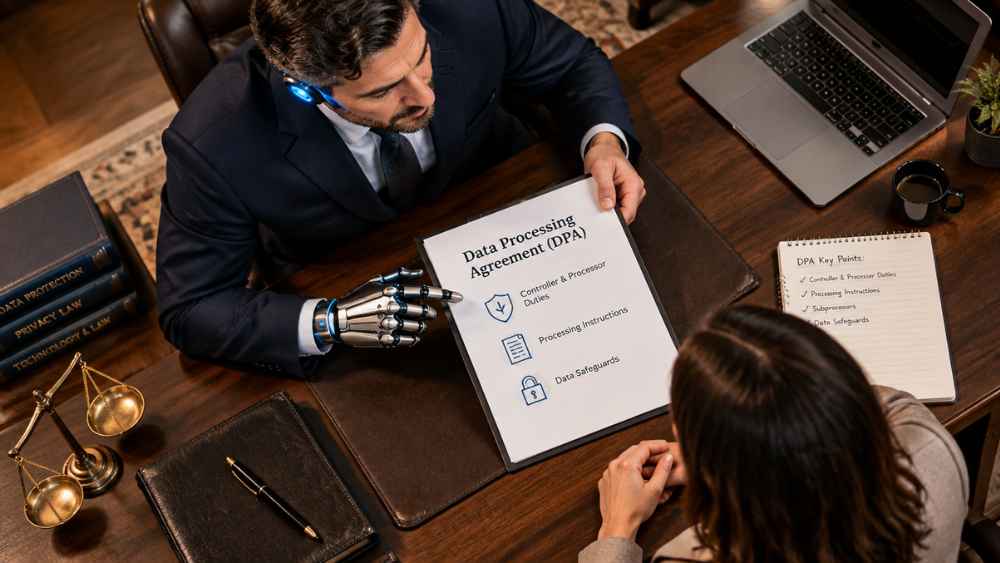
“The customer and cloud provider signed a Data Processing Agreement covering documented instructions, security controls, subprocessors, breach notice, data-subject assistance, audits, transfers, and deletion.”
What Is a Data Processing Agreement (DPA)?
A Data Processing AgreementMaster Service Agreement (MSA)A Master Service Agreement, or MSA, sets recurring legal and commercial terms for an ongoing service relationship. The parties can then use SOWs, order forms, or schedules for project-specific scope, pricing, deliverables, and...View definition , or DPA, is a contract governing how one organization processes personal dataPersonally Identifiable Information (PII)Personally Identifiable Information (PII) is information that can distinguish or trace an individual’s identity alone or with other linked or linkable information. Common examples include identifiers, contact details, biometrics, financial information, health information,...View definition for another.
The agreement commonly defines roles, instructions, security, confidentialityEmployment ContractAn employment contract is an agreement defining terms of an employer-employee relationship. It can cover duties, compensation, benefits, equity, confidentiality, intellectual property, restrictive covenants, termination, severance, and dispute procedures while remaining subject to...View definition , subprocessors, data rights, audits, breach duties, and deletion or return.
GDPR Article 28Data ProcessorA Data Processor processes personal data on behalf of a controller under GDPR terminology. Processors must follow documented instructions, maintain security, control subprocessors, support rights and DPIAs, notify controllers of breaches, maintain required...View definition requires specific controller-processor contract terms when the GDPRData PrivacyData privacy concerns how personal information is collected, used, shared, retained, and controlled. It includes transparency, data minimization, individual rights, vendor management, security, retention, and compliance with laws such as GDPR, CCPA, and...View definition applies.
Standard Data Processing Agreement (DPA) — Sample Contract Language
Suppose a retailer hires a cloud provider to host customer account data.
What Does DPA Stand For?
DPA commonly stands for Data Processing Agreement in privacy contracting.
The abbreviation can have other meanings in other legal contexts.
Therefore, the contract should define the term clearly.
When Is a DPA Required?
Under the GDPR, a controllerData SubjectA Data Subject is an identified or identifiable natural person to whom personal data relates under the GDPR. Data subjects can be customers, employees, applicants, users, children, or other individuals, and they receive...View definition using a processor needs a binding contract or other legal act. Article 28 sets required terms.
Other privacy laws can also require written vendor terms.
Therefore, necessityData MinimizationData Minimization limits personal-data collection, use, access, sharing, and retention to what is genuinely needed for defined purposes. GDPR Article 5(1)(c) and California’s CCPA both impose minimization-style requirements, while privacy-by-design controls help operationalize...View definition depends on the parties, data, role, and governing lawBoilerplate ClauseA boilerplate clause is standardized contract language addressing recurring legal mechanics such as notice, assignment, governing law, waiver, severability, and integration.View definition .
What Is GDPR Article 28?
Article 28 governs processors acting on behalf of controllers.
It requires specified contractual terms and sufficient processor guarantees.
Who Is the Controller?
A controller determines the purposes and meansData ControllerA Data Controller determines the purposes and essential means of processing personal data under GDPR terminology. Controllers carry broad responsibility for lawful bases, transparency, data-subject rights, privacy by design, security, processor selection, DPIAs,...View definition of processing personal data under the GDPR.
The controller selects processors and remains responsible for important compliance duties.
Therefore, role analysis should happen before contract drafting.
Who Is the Processor?
A processor processes personal data on behalf of a controller.
The processor generally acts only on documented controller instructions unless law requires otherwise.
Therefore, independent use can change the legal role.
Can One Company Be Both Controller and Processor?
Yes. The same organization can be a controller for some activities and a processor for others.
Roles depend on the particular processing operation.
Therefore, labels covering the entire business can be inaccurate.
What Must a GDPR DPA Describe?
Article 28 requires the arrangement to describe key processing details.
- Subject matter.
- Duration.
- Nature of processing.
- Purpose of processing.
- Types of personal data.
- Categories of data subjects.
- Controller rights and obligations.
Therefore, the schedule should describe the processing specifically.
What Are Documented Instructions?
Documented instructions tell the processor how the controller authorizes personal-data processing.
They can appear in the DPA, service agreementService AgreementA service agreement is a contract in which one party agrees to perform services for another party in exchange for payment or other consideration. It commonly covers scope, fees, deliverables, service levels, intellectual...View definition , order forms, or other agreed documentation.
Therefore, processing outside instructions can create compliance risk.
Can a Processor Ignore Controller Instructions?
Generally no, unless applicable law requires the processing.
The processor can also have duties to warn when an instruction appears to violate the GDPR.
Therefore, the DPA should provide an escalation process.
What Is a Confidentiality Requirement?
Article 28 requires people authorized to process personal data to commit to confidentiality or face an appropriate statutory dutyNegligence Per SeNegligence per se uses a qualifying statutory or regulatory violation to establish or influence the negligence duty-and-breach analysis when the law was designed to prevent the injury at issue.View definition .
Therefore, workforce access should be controlled and documented.
What Security Terms Belong in a DPA?
A DPA should address appropriate technical and organizational security measures.
Examples can include encryption, access controls, logging, backup, resilience, vulnerability management, and incident responseData Breach NotificationData Breach Notification is legally required notice after qualifying security incidents. GDPR Articles 33 and 34 use regulator and high-risk individual notice rules, while U.S. states apply their own definitions, triggers, timing, content,...View definition .
Therefore, security schedules should reflect actual systems rather than generic promises.
What Is GDPR Article 32?
Article 32 requires appropriate security based on risk.
It references confidentiality, integrity, availability, resilience, restoration, and regular testing.
Therefore, DPA security obligations should connect to risk management.
What Are Technical and Organizational Measures?
Technical and organizational measures, or TOMs, are safeguards used to protect personal data.
Technical measures can include encryption and access controls.
Organizational measures can include policies, training, governance, and vendor oversight.
What Is a Security Schedule?
A security schedule is an exhibit describing contractual security controls.
It can specify minimum safeguards and audit evidence.
Therefore, security obligations can remain detailed without overcrowding the main agreement.
What Is a Subprocessor?
A subprocessor is another processor engaged by a processor to handle personal data for the controller.
GDPR Article 28 requires prior specific or general written authorization from the controller.
Therefore, processor vendor management is part of DPA compliance.
What Is General Subprocessor Authorization?
General authorization allows the processor to add subprocessors subject to notice and contractual conditions.
The controller must receive an opportunity to object where Article 28 requires it.
Therefore, notice procedures should be operationally realistic.
What Is Specific Subprocessor Authorization?
Specific authorization requires controller approval for each named subprocessor.
It gives the controller tighter control but can slow vendor operations.
Therefore, parties should choose an approach that fits the risk and service model.
What Is a Subprocessor Flow-Down?
A flow-down requires the subprocessor to accept data-protection obligations equivalent to the processor’s relevant duties.
The original processor remains responsible for certain subprocessor performance under Article 28.
Therefore, vendor contracts should align across the processing chain.
What Is Data Subject Assistance?
Processors must help controllers respond to data-subject rights requests where Article 28 requires assistance.
That can involve access, deletion, correction, restriction, portability, or objectionObjectionAn Objection is a formal challenge to evidence, testimony, questions, argument, or procedure. Under Federal Rule of Evidence 103, timely and specific objections can prevent inadmissible evidence and preserve evidentiary issues for appeal.View definition workflows.
Therefore, the DPA should explain request-routing and response support.
What Is Breach Assistance?
A processor must notify the controller without undue delay after becoming aware of a GDPR personal-data breach.
The DPA often sets a shorter contractual notification period.
Therefore, incident clauses should support the controller’s legal deadlines.
What Information Should a Breach Notice Include?
The DPA can require facts known about the incident, affected data, likely consequences, mitigationForce MajeureForce Majeure is a contract concept that can excuse or delay performance after extraordinary events covered by the agreement. Relief depends on clause wording, causation, notice, mitigation, exclusions, governing law, and the specific...View definition , and contact information.
Information can sometimes arrive in phases as an investigation develops.
Therefore, early notice should not wait for perfect certainty.
What Is Audit Assistance?
Article 28 requires processors to make information available to demonstrate compliance and support qualifying audits or inspections.
Contracts often define audit frequencyAudit Rights ClauseAn audit rights clause permits defined inspections of records or processes to check contract performance. Learn about audit scope, costs, security, and privacy.View definition and procedures.
Therefore, audit rightsLicensing AgreementA Licensing Agreement is a contract granting permission to use specified property, technology, or intellectual property while the licensor generally retains ownership. Key terms commonly address scope, exclusivity, territory, term, royalties, sublicensing, quality...View definition should balance accountability with security and operational burden.
Can SOC 2 or ISO Reports Satisfy Audit Rights?
They can support compliance reviewCompliance AuditA compliance audit is a structured test of whether laws, policies, contractual obligations, and internal controls are being followed in practice.View definition but do not automatically replace every contractual or legal audit right.
Parties often use third-party certifications as a first audit layer.
Therefore, the DPA should explain when additional review is allowed.
What Happens at the End of Processing?
Article 28 generally requires deletion or return of personal data after services end, at the controller’s choice.
Applicable law can require continued retention.
Therefore, the agreement should address backups and legal-retention exceptions.
What Is Data Return?
Data return means providing personal data back to the controller in an agreed format.
It can support migration to another service.
Therefore, exit provisions should address timing and technical feasibility.
What Is Data Deletion?
Data deletion means removing personal data after the contractual purpose ends, subject to lawful exceptions.
Backup systems can require delayed deletion cycles.
Therefore, deletion commitments should describe realistic technical processes.
What Is a Data Retention Clause?
A retention clause defines how long the processor keeps personal data.
It can reference controller instructions and legal obligations.
Therefore, indefinite retention should be avoided without a valid reason.
What Is an International Data Transfer?
An international transfer can occur when personal data moves or becomes accessible across regulated jurisdictions.
GDPR Chapter V governs transfers to third countries and international organizations.
Therefore, a DPA can need separate transfer safeguardsCross Border Data TransferA cross-border data transfer involves making data available across national or legal boundaries. Privacy laws can require adequacy, contractual safeguards, risk assessment, or other mechanisms before personal data is transferred.View definition .
DPA vs. Standard Contractual Clauses
A DPA governs processing roles and Article 28 obligations.
Standard Contractual ClausesStandard Contractual ClausesStandard Contractual Clauses are pre-approved contractual safeguards used for specified data-protection relationships and international transfers. Correct use requires the right module, accurate annexes, and transfer-risk analysis.View definition , or SCCs, can provide safeguards for certain international data transfersData Localization ClauseA data localization clause limits the countries or regions where specified data may be stored, accessed or processed.View definition .
Therefore, one contract package can include both.
What Is a Transfer Impact Assessment?
A Transfer Impact Assessment evaluates risks and safeguards for certain international transfers.
It can consider destination-country law and supplementary measures.
Therefore, transfer compliance can require more than signing SCCs.
DPA vs. Privacy Policy
A privacy policyPrivacy PolicyA Privacy Policy is a public statement explaining how an organization collects, uses, discloses, retains, protects, and otherwise handles personal information. Applicable privacy laws can require specific disclosures about purposes, rights, recipients, retention,...View definition is a public notice explaining data practices to individuals.
A DPA is a contract allocating processing obligations between organizations.
Therefore, one document cannot replace the other.
DPA vs. NDA
An NDA protects confidential informationNon Disclosure Agreement (NDA)A non disclosure agreement, or NDA, is a contract that protects specified confidential information. It limits who may receive the information and often restricts how the recipient may use or share it.View definition generally.
A DPA addresses personal-data processing obligations and privacy-law requirements.
Therefore, a vendor relationship can require both agreements.
DPA vs. Business Associate Agreement
A HIPAA Business Associate AgreementHIPAAHIPAA is the Health Insurance Portability and Accountability Act of 1996. Its Privacy, Security, and Breach Notification Rules protect certain health information handled by covered entities and business associates and give individuals important...View definition , or BAABusiness Associate Agreement (BAA)A Business Associate Agreement (BAA) is a HIPAA-required contract governing how qualifying vendors and subcontractors may use, protect, and disclose protected health information.View definition , governs specified handling of protected health information.
A GDPR DPA serves a different legal framework.
Therefore, regulated health vendors can need both documents.
Does the CCPA Require Vendor Contracts?
Yes, in defined relationships. California law requires specific written contract terms for service providers and contractors.
The requirements are not identical to GDPR Article 28.
See California CCPA materials effective January 1, 2026.
What CCPA Contract Terms Matter?
California service-provider and contractor agreements must include specific restrictions and business-purpose terms.
They also limit sale, sharing, retention, use, and disclosure in defined ways.
Therefore, a GDPR-only DPA can be insufficient for California roles.
What Is a Service Provider Under the CCPA?
A CCPA service provider processes personal information on behalf of a business under a qualifying written contract.
The contract must satisfy statutory and regulatory requirements.
Therefore, contract defects can affect the vendor’s legal classification.
What Is a Contractor Under the CCPA?
A CCPA contractor receives personal information for a business purpose under a qualifying written contract.
California law imposes specific use and disclosure limits.
Therefore, businesses should classify vendors based on actual roles.
What Is Purpose Limitation in a DPA?
Purpose limitation restricts processing to specified and lawful purposes.
Contract language can reinforce that limitation through documented instructions.
Therefore, broad rights to use data “for any purpose” create privacy risk.
What Is Data Minimization in a DPA?
Data minimizationPrivacy by DesignPrivacy by Design embeds privacy protections into systems, products, and processes from the beginning through proactive controls, privacy-protective defaults, lifecycle security, and user-centered transparency.View definition means limiting personal data to what is appropriate for the processing purpose.
The parties can reduce risk by limiting unnecessary fields and access.
Therefore, the DPA should match the actual dataset.
What Is Confidentiality After Termination?
Confidentiality duties often continue after the service relationship ends.
Trade-secret and privacy obligations can also survive independently.
Therefore, survivalRepresentations and WarrantiesRepresentations and Warranties are contractual statements about facts, authority, condition, compliance, or performance. They allocate information risk and often work with disclosure schedules, knowledge and materiality qualifiers, closing conditions, survival periods, indemnification, and...View definition language should be considered carefully.
What Is Controller Assistance?
Processors can have duties to assist controllers with security, rights, breach response, impact assessments, and regulator consultations.
The nature of assistance depends on processing and available information.
Therefore, assistance obligations should reflect the service architecture.
What Is a Data Protection Impact Assessment?
A Data Protection Impact AssessmentData Protection Impact Assessment (DPIA)A Data Protection Impact Assessment (DPIA) evaluates planned personal-data processing that may create high risk, documenting necessity, proportionality, risks to individuals, mitigations, and any residual-risk concerns.View definition , or DPIAGDPRGDPR is the European Union’s General Data Protection Regulation, the main EU framework governing personal-data processing. It gives individuals substantial rights and imposes duties involving lawful processing, transparency, security, governance, breaches, and international...View definition , evaluates high-risk personal-data processing under the GDPR.
Processors must assist controllers where Article 28 requires it.
Therefore, high-risk services should support relevant assessment information.
Who Pays for DPA Compliance Work?
The contract can allocate costs for audits, rights requests, investigations, security changes, and regulatory cooperation.
However, a party cannot contract away mandatory legal duties.
Therefore, cost allocation should be explicit.
What Is a DPA Liability Clause?
A DPA can allocate contractual liabilityLiability DefinitionLiability means legal responsibility for an act, omission, debt, loss, or other obligation. Liability can arise from negligence, contracts, statutes, strict-liability rules, or responsibility for another person’s conduct.View definition for privacy breaches, security incidents, fines, claims, or indemnityThird Party ComplaintA third-party complaint uses Rule 14 impleader to bring a nonparty into a lawsuit when that person may be liable to a defending party for all or part of the original claim.View definition .
Mandatory law can limit enforceability of some provisions.
Therefore, liability terms should align with the main services agreement.
Can a DPA Have a Liability Cap?
Yes. Parties often negotiate whether privacy obligations fall within or outside a general liability capLimitation of Liability ClauseA limitation of liability clause sets contractual boundaries on recoverable losses or exposure. Learn how liability caps, exclusions, carve-outs, super caps, and indemnity terms work, with negotiation examples and enforceability considerations.View definition .
Risk allocation varies by bargaining power and data sensitivity.
Therefore, cross-references between agreements should be checked.
What Is a DPA Order of Precedence Clause?
An order of precedence explains which document controls when contract terms conflict.
The DPA can take priority for data-protection matters.
Therefore, contract hierarchy can prevent inconsistent obligations.
Data Processing Agreement Example
Suppose a retailer hires a cloud provider to host customer account data.
The retailer acts as controller, while the cloud provider processes data on documented instructions.
The DPA covers security, subprocessors, breach noticeNotice of BreachA Notice of Breach is a written communication stating that one party believes another party violated a contract or legal obligation. It commonly identifies the breach, relevant contract terms, supporting facts, required cure,...View definition , rights assistance, audits, transfers, and deletion.
Why Does a DPA Matter?
A DPA translates privacy-law responsibilities into operational duties between organizations handling personal data.
However, a template cannot determine legal roles automatically.
The key questions are practical. Who controls the processing? What data is involved? Which laws apply? What security, transfer, and breach duties are required?
What If Controller Instructions Conflict?
A DPA should identify the source of authorized instructions: the agreement itself, signed schedules, permitted ticketing channels, and named customer roles. Conflicts often appear when a sales email contradicts a formally approved processing instruction about recipients, retention, deletion, cross-border transfers, security controls, data-subject requests, or subprocessors.
Contracts can require the processor to pause the disputed step, escalate to an authorized controller contact, and document the interim handling. Where applicable law requires notice that an instruction appears unlawful, the commercial review process should not delay that legal noticeConstructive NoticeConstructive notice is legally imputed knowledge arising from a recognized notice method, such as public recording or other circumstances that the law treats as sufficient notice.View definition . Distinguish a routine clarification from a true conflict so ordinary support questions do not freeze processing.