
Patent Infringement
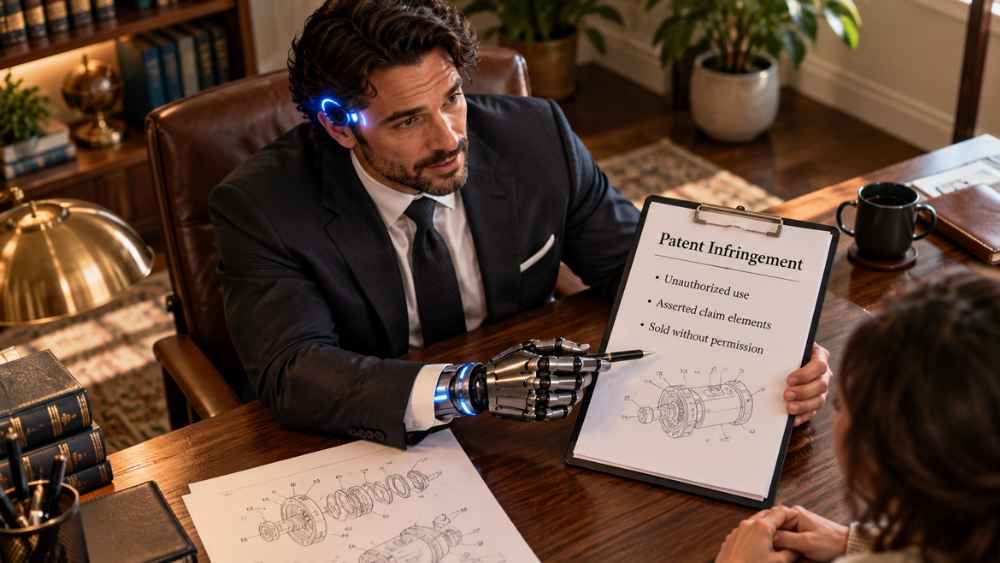
“The patent owner alleged Patent Infringement because the accused product contained every limitation of the asserted claim and was sold without authorization.”
What Is Patent Infringement?
Patent infringementPatent DefinitionA patent is a federal right that can exclude others from making, using, selling, offering, or importing a protected invention. U.S. patents can cover qualifying utility inventions, ornamental designs, and certain plants.View definition occurs when a person performs an act prohibited by the Patent Act without the patent owner’s authority.
Direct infringementCopyright InfringementCopyright infringement occurs when someone violates an exclusive copyright right without authorization or another valid legal basis. Claims can involve copying, derivative works, distribution, performance, display, or secondary liability, subject to defenses and...View definition can include making, using, selling, offering to sell, or importing a patented invention.
See 35 U.S.C. § 271.
Standard Patent Infringement — Sample Contract Language
Suppose a company sells a product containing every limitation of an unexpired patent claimPatent ClaimA patent claim is a numbered legal statement defining the scope of patent protection and serving as the central unit for examination, validity, infringement, and licensing analysis.View definition without permission.
What Is Direct Patent Infringement?
Section 271(a) defines the core acts of direct infringement within the United States.
Direct infringement generally does not require proof of intent to infringe.
Therefore, good faithBusiness Judgment RuleThe Business Judgment Rule is a judicial presumption protecting qualifying corporate decisions from hindsight review. Its application varies by jurisdiction but commonly depends on informed decision-making, disinterest, independence, good faith, and compliance with...View definition alone does not defeat direct liability.
What Acts Can Directly Infringe a Patent?
Unauthorized commercial or technical activity can infringe during the patent term.
Therefore, patent clearance should occur before launch.
- Making the patented invention.
- Using the patented invention.
- Offering the patented invention for sale.
- Selling the patented invention.
- Importing the patented invention into the United States.
What Is a Patent Claim?
A patent claim defines the legal boundaries of the patented invention.
Infringement analysis compares each asserted claim with the accused product or process.
Therefore, drawingsPatent ApplicationA Patent Application is a filing asking the USPTO to examine an invention for patent protection. Provisional and nonprovisional applications differ in purpose, requirements, examination, timing, publication, and their relationship to later patent...View definition and descriptions do not replace claim analysis.
What Is Claim Construction?
Claim construction determines the legal meaning and scope of disputed claim language.
Courts consider the claim text, specification, prosecution history, and appropriate external evidence.
Therefore, claim meaning can decide infringement.
What Is Literal Infringement?
Literal infringement occurs when the accused product or process contains every required claim limitation.
Missing one required limitation defeats literal infringement of that claim.
Therefore, element-by-element comparison is essential.
What Is the All-Elements Rule?
The all-elements rule requires every claim limitation to be satisfied directly or through an applicable equivalent.
An accused device cannot infringe by matching only the invention’s general concept.
Therefore, each limitation matters.
What Is the Doctrine of Equivalents?
The doctrine of equivalents can find infringement despite nonliteral differences in qualifying circumstances.
It prevents trivial substitutions from avoiding patent rights.
However, prosecution history and other limits can restrict the doctrine.
What Is Prosecution History Estoppel?
Prosecution history estoppelEstoppelEstoppel is a family of doctrines preventing a party from asserting a position when law treats that position as unfair, inconsistent, or already resolved. Major forms include equitable, promissory, collateral, judicial, and silence-based...View definition can limit equivalents after a patentee narrows claims during prosecution.
The doctrine protects public reliance on the patent record.
Therefore, amendment history matters.
What Is Induced Infringement?
Section 271(b) imposes liability on a person who actively induces patent infringement.
The claim requires direct infringement by another person plus the required knowledge and encouragement.
Therefore, passive product distribution alone may be insufficient.
What Did Hikma v. Amarin Clarify in 2026?
In 2026, the Supreme CourtSupreme CourtThe Supreme Court of the United States is the nation’s highest federal court. It reviews selected cases involving the Constitution and federal law, resolves important federal legal questions, and sits at the top...View definition clarified the active-steps requirement for induced infringement.
A complaintCivil LawsuitA civil lawsuit is a noncriminal court action in which a plaintiff seeks a legal remedy from a defendant. The process can include jurisdiction, pleadings, service, discovery, motions, settlement, trial, judgment, enforcement, and...View definition must plausibly allege affirmative encouragement of infringement, not merely a possible infringing interpretation.
See Hikma Pharmaceuticals USA Inc. v. Amarin Pharma, Inc..
What Are the Elements of Induced Infringement?
Current Supreme Court doctrine identifies several core requirements.
Therefore, knowledge and active encouragement distinguish inducement from direct infringement.
- Direct infringement by a third party.
- Knowledge that the induced acts constitute patent infringement.
- Active steps encouraging the infringing conduct.
What Is Contributory Infringement?
Section 271(c) addresses certain components specially made or adapted for infringement.
The component generally cannot be a staple article suitable for substantial noninfringing use.
Therefore, component design and knowledge matter.
What Is a Staple Article?
A staple article has substantial legitimate noninfringing uses.
Selling a general-purpose product usually does not create contributory liability by itself.
Therefore, product versatility can matter.
Can Supplying Components Abroad Create Liability?
Section 271(f) can create liability for certain U.S.-supplied components combined abroad.
However, the statutory requirements differ from ordinary domestic infringement.
Therefore, global supply chains require separate analysis.
What Is Process-Patent Importation Liability?
Section 271(g) can cover certain products imported into the United States after manufacture by a patented process.
Statutory exceptions and material-change rules apply.
Therefore, process patentsIntellectual PropertyIntellectual property, or IP, is a group of legal rights that protect certain inventions, creative works, brands, and confidential business information. Major U.S. categories include patents, copyrights, trademarks, and trade secrets.View definition can affect imported goods.
What Is the Regulatory Safe Harbor?
Section 271(e)(1) protects qualifying uses reasonably related to developing information for federal regulatory submissions.
The safe harborMotion for SanctionsA motion for sanctions asks a court to penalize or correct litigation misconduct. The legal standard, safe-harbor rules, notice requirements, and available remedies depend on the authority invoked.View definition is important in pharmaceutical and medical-device development.
Therefore, otherwise infringing experimental use can sometimes receive statutory protection.
What Is Hatch-Waxman Artificial Infringement?
Section 271(e)(2) defines specialized infringement involving certain drug and biological-product regulatory applications.
It allows patent disputes before commercial launch.
Therefore, pharmaceutical patent litigationLegal DisputeA legal dispute is a disagreement or controversy involving claimed legal rights, duties, liabilities, property, or remedies. It can be resolved through negotiation, mediation, arbitration, administrative proceedings, litigation, or settlement depending on the...View definition follows specialized procedures.
Who Can Sue for Patent Infringement?
A patent owner can bring a civil action under 35 U.S.C. § 281.
Exclusive licensees can sometimes have standingJudicial ReviewJudicial review is the power of courts to examine government action and determine whether it complies with the Constitution, statutes, and other controlling law. It can apply to legislation, executive action, and administrative...View definition depending on transferred rights.
Therefore, ownership and licensing documents matter.
Where Are Patent Infringement Cases Filed?
Patent infringement claims arise under federal law and are generally heard in federal district courtFederal District CourtA Federal District Court is a United States trial court that hears federal civil and criminal cases within jurisdiction granted by Congress and the Constitution.View definition .
Special patent venue rules also apply.
Therefore, subject-matter jurisdiction does not answerCivil LitigationCivil Litigation is the court process for resolving noncriminal disputes through pleadings, motions, discovery, settlement, trial, judgment, and possible appeal. Federal civil litigation follows the Federal Rules of Civil Procedure, while state systems...View definition venue.
What Is Patent Venue?
35 U.S.C. § 1400(b) provides the specialized venue rule for patent infringement actions.
Corporate venue follows Supreme Court and Federal CircuitCircuit CourtCircuit Court can mean different institutions depending on the jurisdiction. In federal practice, the phrase commonly refers to a U.S. Court of Appeals, while many states use circuit court for a general-jurisdiction trial...View definition Circuit precedentBinding PrecedentBinding Precedent is a judicial holding that a lower court must follow when it controls the legal issue within the relevant hierarchy and jurisdiction. Its force depends on the deciding court, the actual...View definition .
Therefore, venue should be analyzed before filing.
What Is a Noninfringement Defense?
An accused infringer can argue that one or more claim limitations are missing.
It can also challenge the plaintiff’s claim construction.
Therefore, technical comparison is central to defense strategy.
Can Patent Invalidity Be a Defense?
Yes. Section 282 recognizes invalidity defenses in infringement litigation.
An issued patent is presumed valid.
Therefore, accused infringers can challenge patentabilityPrior ArtPrior art is legally available information used to evaluate whether patent claims are novel and nonobvious, including qualifying patents, publications, public uses, sales, and other disclosures.View definition while contesting infringement.
What Patent Validity Defenses Are Common?
Common defenses can involve anticipation, obviousness, written description, enablement, or patent-eligible subject matter.
Different statutesPrimary AuthorityPrimary Authority is law issued by an institution with official power to create or state legal rules. Constitutions, statutes, regulations, court decisions, and court rules can be primary authority, while binding effect depends...View definition govern each theory.
Therefore, invalidity analysis can require extensive prior-art and expert work.
What Is Patent Unenforceability?
A patent can also face unenforceability defenses in qualifying circumstances.
Inequitable conduct is one specialized doctrine.
Therefore, validity and enforceability are distinct.
What Is Willful Patent Infringement?
Willful infringement concerns especially culpable infringement conduct.
It can support enhanced damagesLegal RemedyA legal remedy is the relief a court or other authorized tribunal can provide after a legal right has been violated. Remedies can include damages, injunctions, restitution, specific performance, rescission, declarations, and other...View definition under Section 284.
Therefore, notice of a patent can become important to risk management.
What Damages Are Available?
Section 284 requires damages adequate to compensate for infringement.
The award cannot be less than a reasonable royaltyCopyright LicenseA Copyright License grants permission to exercise specified copyright rights while ownership can remain with the licensor. Exclusive and nonexclusive licenses differ in legal effect, writing requirements, transferability, and enforcement.View definition for the infringing use.
See 35 U.S.C. § 284.
What Is a Reasonable Royalty?
A reasonable royalty estimates the license payment the parties would have negotiated for the patented use.
Experts often use comparable licenses and economic evidence.
Therefore, the royalty base and rate can drive damages.
What Are Lost Profits?
Lost profitsCompensatory DamagesCompensatory Damages reimburse proven loss or injury and are often called actual damages. They can include economic and noneconomic losses, subject to causation, certainty, foreseeability, mitigation, statutory limits, and the governing measure of...View definition compensate a patent owner for sales or profit lost because of infringement.
The owner must prove causationBreach of DutyA breach of duty occurs when a person or entity fails to meet a legal duty owed to another person. In negligence cases, breach is usually one element alongside duty, causation, and damages,...View definition and amount.
Therefore, market demand and noninfringing alternatives can matter.
Can Patent Damages Be Enhanced?
Yes. Section 284 permits increased damages, potentially up to three times the amount assessed.
Supreme Court doctrine reserves enhancement for egregious infringement behavior.
Therefore, ordinary infringement does not automatically produce treble damages.
Can a Court Grant an Injunction?
Yes. Section 283 authorizes injunctions according to equitable principles.
See 35 U.S.C. § 283.
Therefore, infringement alone does not guarantee an injunctionCease and Desist LetterA cease and desist letter is a written demand asking a person or business to stop specified allegedly unlawful or harmful conduct. It is generally not a court order, but it can provide...View definition .
What Did eBay v. MercExchange Establish?
The Supreme Court held that permanent patent injunctions require the traditional four-factor equitable test.
Courts cannot apply an automatic injunction rule.
Therefore, remedyCause of ActionA Cause of Action is a recognized set of legal elements supporting a right to judicial relief. Its elements can arise from statutes, constitutions, regulations, or case law, and the claimant generally must...View definition evidence matters separately from liability.
Can Attorney Fees Be Awarded?
Section 285 allows reasonable attorney feesMotion to CompelA motion to compel asks a court to order required discovery or disclosure when another party or person has not responded adequately. In federal civil cases, Rule 37 generally requires good-faith conference efforts...View definition to the prevailing party in exceptional cases.
The court evaluates the totality of circumstances.
Therefore, fee shiftingAttorney's FeesAttorney's fees are legal-service charges that generally remain each party's responsibility under the American Rule unless a statute, contract, rule, or exception authorizes fee shifting.View definition is possible but not routine.
What Is the Patent Damages Limitation Period?
Section 286 generally limits recovery to infringement occurring within six years before the complaint or counterclaimAnswer to ComplaintAn Answer to Complaint is the defendant’s formal pleading responding to a civil complaint. It typically admits or denies allegations, states insufficient knowledge where appropriate, asserts defenses, and can include counterclaims, jury demands,...View definition .
This rule limits damages rather than creating a simple filing deadlineStatute of LimitationsA statute of limitations is a law that sets a deadline for starting a legal claim. The deadline varies by jurisdiction and claim type, and rules about accrual, discovery, tolling, or repose can...View definition .
Therefore, older infringement can affect litigation differently.
What Is Patent Marking?
Section 287 can limit pre-suit damages when patented articles were not properly marked.
Actual noticeConstructive NoticeConstructive notice is legally imputed knowledge arising from a recognized notice method, such as public recording or other circumstances that the law treats as sufficient notice.View definition can sometimes begin the damages period.
Therefore, patent owners should review marking practices.
What Is Virtual Patent Marking?
Patent owners can use qualifying virtual marking that links products to an online patent list.
The statutory requirements must be satisfied.
Therefore, website maintenance can affect damages.
Can Patent Infringement Be Accidental?
Yes. Direct infringement generally can occur without knowledge of the patent.
Intent becomes more important for inducement and enhanced damages.
Therefore, freedom-to-operate review can reduce risk.
What Is a Freedom-to-Operate Search?
A freedom-to-operate review examines active patents that could cover a planned product or process.
It differs from a patentability search.
Therefore, obtaining a patent does not guarantee freedom to use the invention.
What Is a Patentability Search?
A patentability search looks for prior art affecting whether an invention can receive a patent.
It does not determine infringement of another active patent.
Therefore, patentability and infringement are separate questions.
Can a Patent Be Challenged at the PTAB?
Accused infringers can sometimes challenge patent validity before the Patent TrialLawsuitA lawsuit is a legal dispute brought before a court for a decision or remedy. Civil lawsuits can involve pleadings, service, discovery, motions, settlement, trial, judgment, and possible appeal.View definition and AppealCourt of AppealsA court of appeals is a court that reviews decisions from lower courts. Federal courts of appeals usually examine the existing record for legal error rather than conducting a new trial or hearing...View definition Board.
Inter partes review is a common procedure for qualifying patents and grounds.
Therefore, district-court and PTAB strategies can interact.
What Is an Inter Partes Review?
An inter partes review, or IPR, challenges specified patent claims based on patents or printed publications.
Statutory timing and estoppel rules apply.
Therefore, filing decisions should be coordinated with litigation.
Patent Infringement Example
Suppose a company sells a product containing every limitation of an unexpired patent claim without permission.
The patent owner can allege direct infringement under Section 271(a).
Damages and equitable reliefInjunctive ReliefInjunctive relief is an equitable remedy ordering a party to act or stop acting when monetary damages would be inadequate to prevent or remedy the harm.View definition would require separate proof.
Why Does Patent Infringement Matter?
Patent infringement law defines how exclusive patent rights are enforced against unauthorized products and processes.
Current law also distinguishes direct, induced, and contributory liability carefully.
Therefore, claim language, technical facts, knowledge, and remedies all require separate analysis.