
Best Evidence Rule
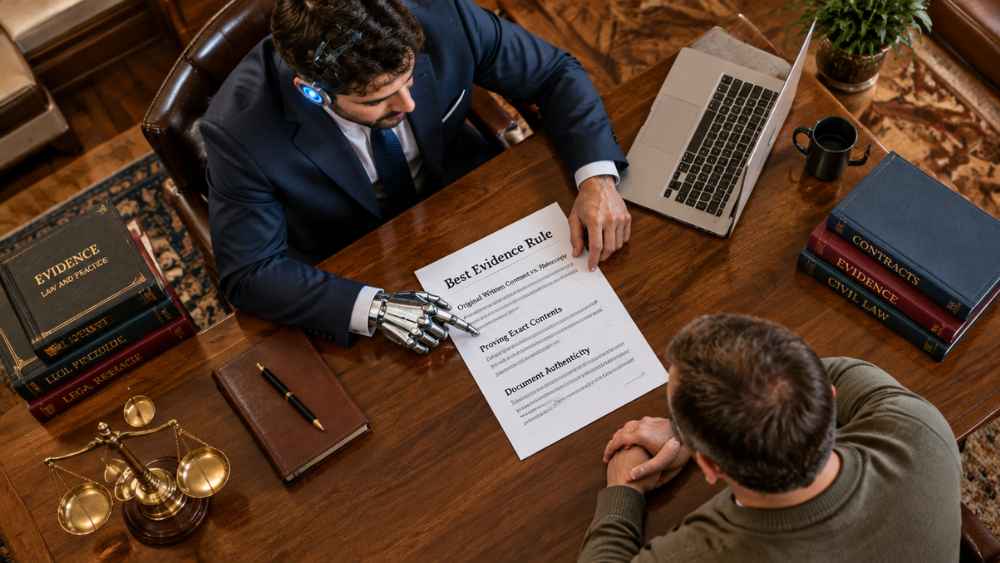
“The court applied the Best Evidence Rule because the party sought to prove the exact contents of a written contract using a duplicate.”
What Is the Best Evidence Rule?
The Best Evidence RuleDigital EvidenceDigital Evidence is electronically stored, transmitted, or generated information offered to prove a fact. Emails, texts, video, photographs, metadata, logs, cloud data, and device records can be evidence, but relevance, authentication, hearsay, integrity,...View definition generally requires an original writing, recording, or photograph when a party seeks to prove its content.
Federal Rule of Evidence 1002 states the core rule.
Therefore, the doctrine is more accurately called the original-writing rule. See Federal Rule of Evidence 1002.
Standard Best Evidence Rule — Sample Contract Language
Suppose a party claims a written contract contains a specific termination clauseTermination ClauseA Termination Clause defines when and how parties can end a contract, including cause, convenience, notice, cure periods, fees, and effective dates. Strong clauses also address accrued payments, surviving obligations, confidentiality, data return,...View definition .
Does the Rule Require the Best Available Evidence?
No. The name can be misleading.
The rule does not generally require parties to present the strongest or most persuasive evidence.
Therefore, it focuses specifically on proving content of writings, recordings, and photographs.
When Does Rule 1002 Apply?
Rule 1002 applies when a party seeks to prove the content of a writing, recording, or photograph.
If a party does not seek to prove content, the rule may not apply.
Therefore, first identify the fact the party seeks to prove.
What Is a Writing Under Rule 1001?
Rule 1001 defines writings broadly to include letters, words, numbers, or equivalent information recorded in any form.
Electronic records can qualify.
Therefore, the rule extends far beyond paper documents. See Federal Rule of Evidence 1001.
What Is a Recording?
A recording includes letters, words, numbers, or equivalent information recorded in a manner that can be perceived.
Audio and digital recordings can qualify.
Therefore, the Rule covers many electronic formats.
What Is a Photograph?
Rule 1001 includes still photographs, X-rays, video recordings, and similar forms.
The definition is functional rather than limited to printed photos.
Therefore, visual digital evidence can trigger Article X.
What Counts as an Original?
For electronically stored informationRequest for ProductionA Request for Production is a civil discovery request for documents, electronically stored information, tangible things, or inspection access. In federal court, Rule 34 governs requests to parties and sets requirements for particularity,...View definition , an original includes any printout or readable output that accurately reflects the information.
Other items use the Rule 1001 definition.
Therefore, the original need not always be the physical storage device.
Can There Be More Than One Original?
Yes. Counterparts intended to have the same effect can each qualify as originals.
Multiple photographic impressions can also qualify.
Therefore, “original” does not always mean a single unique object.
What Is a Duplicate?
A duplicate is a counterpart produced by a method that accurately reproduces the original.
Photocopies and reliable digital copies commonly qualify.
Therefore, duplicate status depends on accurate reproduction.
Are Duplicates Admissible?
Yes. Rule 1003 generally admits a duplicate to the same extent as the original.
Two important exceptions apply.
Therefore, copies are usually sufficient. See Federal Rule of Evidence 1003.
When Can a Duplicate Be Rejected?
A court can exclude a duplicate when a genuine question exists about the original’s authenticity.
A court can also exclude the duplicate when admissionDirect EvidenceDirect Evidence proves a fact without requiring an additional inference about that fact. Examples can include eyewitness testimony, admissions, recordings, photographs, contracts, and other evidence that directly addresses the disputed issue.View definition would be unfair.
Therefore, original production matters most when parties dispute authenticity or completeness.
Does a Photocopy Satisfy the Rule?
Usually, yes, when it qualifies as an accurate duplicate under Rule 1003.
A genuine authenticity dispute can change the result.
Therefore, photocopies are not automatically second-rate evidence.
Can a Screenshot Satisfy the Rule?
Potentially. A screenshot can function as a duplicate or other proof depending on how accurately it captures the content.
AuthenticationAdmissible EvidenceAdmissible Evidence is evidence a court permits the judge or jury to consider. In federal court, admissibility commonly depends on relevance, Rule 403 balancing, authentication, foundation, hearsay rules, privilege, witness competence, and other...View definition remains a separate requirement.
Therefore, screenshots should preserve context and source information.
Can a Printout of Electronic Data Be an Original?
Yes. Rule 1001 treats a readable output as an original when it accurately reflects electronically stored information.
This rule is important for emails and databases.
Therefore, digital evidence does not require producing a server or hard drive.
What If the Original Is Lost?
Rule 1004 allows other evidence of content when all originals are lost or destroyed without the proponent’s bad faithGood FaithGood Faith is a context-dependent legal concept involving honesty, fair dealing, and faithful performance. Contract law, the UCC, insurance, corporate fiduciary law, and bankruptcy use related but distinct good-faith standards.View definition .
The proponent must satisfy the rule’s conditions.
Therefore, accidental loss does not automatically prevent proof. See Federal Rule of Evidence 1004.
What If the Original Is Destroyed?
Rule 1004 can allow other evidence when originals were destroyed without the proponent’s bad faith.
Intentional destruction to gain an evidentiary advantage creates a different problem.
Therefore, preservation conduct matters.
What If the Original Cannot Be Obtained?
Rule 1004 permits other evidence when no available judicial process can obtain the original.
The proponent should show the relevant inability.
Therefore, unavailability can excuse original production.
What If the Opponent Has the Original?
Rule 1004 can permit other proof when the opponent controls the original and fails to produce it after proper notice.
The rule prevents strategic withholding.
Therefore, notice can be important.
What If the Writing Is Collateral?
Rule 1004 allows other evidence when the writing, recording, or photograph is not closely related to a controlling issue.
The rule avoids unnecessary formality for collateral matters.
Therefore, importance to the case matters.
What Is Rule 1005?
Rule 1005 governs use of copies of public records to prove content.
Certified or verified copies generally receive preference.
Therefore, public-record content has its own proof rule.
What Is Rule 1006?
Rule 1006 allows summaries, charts, or calculations to prove the content of voluminous admissible materials.
The underlying originals or duplicates must be available for examination or copying.
Therefore, summaries can simplify large evidentiary records. See Federal Rule of Evidence 1006.
Are Rule 1006 Summaries Evidence?
Yes. The 2024 amendment clarifies that courts may admit qualifying Rule 1006 summaries as substantive evidence.
Illustrative aids instead fall under Rule 107Demonstrative EvidenceDemonstrative evidence uses visuals, models, diagrams, animations, or similar material to explain evidence. Federal Rule 107 distinguishes illustrative aids from exhibits admitted as substantive evidence.View definition .
Therefore, lawyers should distinguish summary evidence from demonstrative aids.
What Is Rule 1007?
Rule 1007 permits proving content through the opposing party’s testimony, depositionCivil LitigationCivil Litigation is the court process for resolving noncriminal disputes through pleadings, motions, discovery, settlement, trial, judgment, and possible appeal. Federal civil litigation follows the Federal Rules of Civil Procedure, while state systems...View definition , or written statement.
The proponent need not account for the original first.
Therefore, a party admission can establish document content.
What Is Rule 1008?
Rule 1008 allocates certain factual questions about originals and evidence of content between judgeJudgeA Judge is a judicial officer who presides over legal proceedings, applies law, manages procedure, rules on motions and evidence, and issues orders or judgments. Trial, appellate, Article III, magistrate, bankruptcy, and state...View definition and juryJuryA Jury is a group of citizens selected to perform a legal factfinding or charging function. Petit juries decide facts and return verdicts in trials, while grand juries determine whether probable cause supports...View definition .
The jury can decide specified authenticity and content issues.
Therefore, Article X includes procedural as well as substantive rules.
Best Evidence Rule vs. Authentication
The Best Evidence Rule asks whether a party uses the proper form of proof to establish content.
Authentication asks whether the item is what the proponent claims.
Therefore, both requirements can apply to the same exhibit.
Best Evidence Rule vs. Hearsay
Article X addresses proof of content.
Hearsay rules address statements offered for their truth.
Therefore, satisfying the Best Evidence Rule does not solve hearsay.
Does the Rule Apply to Witness Memory of an Event?
Not necessarily. A witness can testify from personal knowledgeDirect ExaminationDirect Examination is questioning of a witness by the party that called the witness. It generally uses nonleading questions to establish personal knowledge, foundation, facts, exhibits, and expert opinions before cross-examination.View definition about an event even if a record of the event exists.
The rule applies when the witness seeks to prove the record’s content.
Therefore, lawyers should separate event testimony from content testimony.
Does the Rule Apply to Contract Terms?
Yes, when a party seeks to prove the contents of a written contract.
An original, duplicate, or authorized substitute must satisfy Article X.
Therefore, contract litigationContract DisputeA contract dispute is a disagreement about contract formation, meaning, performance, breach, termination, or remedies.View definition frequently implicates the rule.
Does the Rule Apply to Recorded Conversations?
Yes, when a party seeks to prove what the recording contains.
A duplicate recording can usually satisfy Rule 1003.
Therefore, recording integrity and authenticity can become important.
Does the Rule Apply to Photographs?
Yes, when a party seeks to prove the photograph’s contents themselves.
Some testimony can instead establish the underlying event independently.
Therefore, the purpose for offering the evidence controls.
What Is Secondary Evidence?
Secondary evidence means other proof of content when an original is unavailable under a recognized rule.
Rule 1004 does not create a rigid hierarchy among permitted substitutes.
Therefore, testimony can sometimes prove content once the original requirement is excused.
Best Evidence Rule Example
Suppose a party claims a written contract contains a specific termination clause.
The party offers an accurate duplicate of the signed agreement.
Therefore, Rule 1003 usually allows the duplicate instead of the original.
Why Does the Best Evidence Rule Matter?
The rule reduces disputes about inaccurate recollection or reproduction when documentary content itself matters.
Modern rules also accommodate reliable copies and electronic records.
Therefore, the doctrine protects accuracy without demanding originals in every case.