
Strict Liability
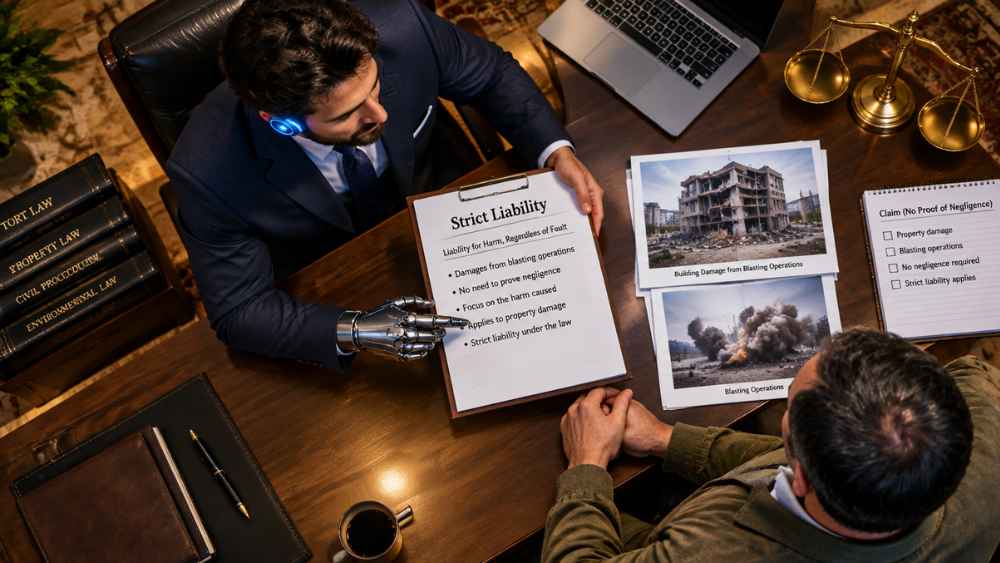
“The property owner alleged Strict Liability after blasting operations damaged the building even though the contractor claimed it used extensive safety precautions.”
What Is Strict Liability?
Strict LiabilityTort DefinitionA tort is a civil wrong arising from an act or omission that causes legally recognized injury or harm. Major tort categories include intentional torts, negligence, and strict liability, with remedies commonly including...View definition imposes liability without requiring proof of intent or ordinary negligenceBreach of DutyA breach of duty occurs when a person or entity fails to meet a legal duty owed to another person. In negligence cases, breach is usually one element alongside duty, causation, and damages,...View definition for the covered conduct.
The doctrine appears in tort law and some criminal statutesPrimary AuthorityPrimary Authority is law issued by an institution with official power to create or state legal rules. Constitutions, statutes, regulations, court decisions, and court rules can be primary authority, while binding effect depends...View definition .
Therefore, liability can arise even when a defendantCivil CourtCivil court is a general term for a court handling noncriminal disputes involving people, businesses, organizations, or government entities. Civil cases can involve contracts, injuries, property, employment, civil rights, and other disputes and...View definition used reasonable careReasonable Person StandardThe Reasonable Person Standard is an objective legal measure used to evaluate whether conduct was reasonably careful under the circumstances. It is central to negligence law and can be adjusted for children, physical...View definition . See Cornell LII’s Strict Liability overview.
Standard Strict Liability — Sample Contract Language
Blasting with explosives is a classic example of an activity that can trigger strict liability.
Strict Liability vs. Negligence
Negligence generally asks whether the defendant failed to use reasonable care.
Strict liability can apply without proving that failure.
Therefore, the plaintiff’s burden focuses on other required elements.
Does Strict Liability Mean Automatic Liability?
No. The plaintiff still must prove every element required by the strict-liability claim.
Causation, defect, injury, ownership, or activity requirements can still matter.
Therefore, strict liability eliminates some fault questions but not all proof.
What Are Common Tort Categories?
Traditional tort law recognizes several recurring strict-liability settings.
The precise rules vary by jurisdictionLegal DisputeA legal dispute is a disagreement or controversy involving claimed legal rights, duties, liabilities, property, or remedies. It can be resolved through negotiation, mediation, arbitration, administrative proceedings, litigation, or settlement depending on the...View definition .
Therefore, the category should be identified first.
- Abnormally dangerous activities.
- Certain harms involving animals.
- Strict products liability.
What Is an Abnormally Dangerous Activity?
An abnormally dangerous activity creates unusual risk that cannot be eliminated through reasonable care.
Courts consider multiple factors.
Therefore, ordinary dangerous activities do not automatically qualify.
What Factors Identify an Abnormally Dangerous Activity?
Courts can consider the likelihood and severity of harm, inability to eliminate risk, common usage, location, and community value.
RestatementSecondary AuthoritySecondary Authority explains, summarizes, analyzes, or critiques law without creating binding legal rules. Treatises, law reviews, Restatements, legal encyclopedias, practice guides, ALR annotations, and dictionaries can help researchers understand doctrine and locate controlling...View definition formulations influence many jurisdictions.
Therefore, classification is highly fact-specific.
What Is a Classic Example?
Blasting with explosives is a classic example of an activity that can trigger strict liability.
The doctrine can apply because blast risks remain despite careful precautions.
Therefore, reasonable care may not defeat liability.
Can Hazardous Chemicals Trigger Strict Liability?
Potentially. Storage or use of unusually dangerous substances can qualify under some circumstances.
Location and common usage matter.
Therefore, the same substance can receive different treatment in different settings.
What Is Animal Strict Liability?
Owners or keepers can face strict liability for harms caused by certain animals under common lawCommon LawCommon law is law developed through judicial decisions rather than created only through statutes or regulations. Courts use precedent to apply and refine common-law rules, although legislatures can modify or replace those rules.View definition or statuteStatutory LawStatutory law is written law enacted by a legislative body through the formal lawmaking process. Federal and state statutes can create rights, duties, prohibitions, causes of action, procedures, penalties, and remedies, and courts...View definition .
Rules differ between wild and domestic animals.
Therefore, species and known dangerous tendencies can matter.
What Are Wild Animals?
Keeping wild animals can trigger strict liability for harms characteristic of the animal’s dangerous nature.
The owner’s careful handling may not eliminate liability.
Therefore, possession itself can create risk allocation.
What About Domestic Animals?
Domestic animal liability often depends on knowledge of dangerous tendencies or specific statutes.
Dog-bite laws vary considerably by state.
Therefore, there is no single nationwide rule.
What Is Strict Products Liability?
Strict products liability can hold qualifying sellers responsible for injuries caused by defective products.
The plaintiff generally need not prove negligent manufacturing or design conduct.
Therefore, product defect replaces ordinary fault as the central issue.
What Is a Manufacturing Defect?
A manufacturing defect occurs when a particular product departs from its intended design.
The product can be more dangerous than identical units.
Therefore, production error can create strict-liability exposure.
What Is a Design Defect?
A design defect concerns an allegedly unsafe product design rather than a manufacturing mistake.
Jurisdictions use different risk-utility and consumer-expectation approaches.
Therefore, design-defect law varies significantly.
What Is a Failure-to-Warn Claim?
A warning defect involves inadequate instructions or warnings about nonobvious product risks.
State law differs on fault and strict-liability treatment.
Therefore, warning claims require jurisdiction-specific analysis.
Who Can Be Liable in a Product Chain?
Manufacturers, distributors, retailers, and other commercial sellers can face liability under applicable state law.
Statutory protections can limit claims against nonmanufacturing sellers.
Therefore, supply-chain position matters.
Does Strict Liability Require a Contract With the Seller?
Generally, modern products-liability law does not require direct contractual privity in every jurisdiction.
The injured person can sometimes sue commercial sellers without buying directly from them.
Therefore, tort liabilityNegligence Per SeNegligence per se uses a qualifying statutory or regulatory violation to establish or influence the negligence duty-and-breach analysis when the law was designed to prevent the injury at issue.View definition can extend beyond contract parties.
What Is Causation in Strict Liability?
The plaintiff must still connect the strict-liability condition to the injury.
Actual and proximate causation concepts can apply.
Therefore, strict liability does not remove causation.
What Damages Can Be Recovered?
Recoverable damagesLegal RemedyA legal remedy is the relief a court or other authorized tribunal can provide after a legal right has been violated. Remedies can include damages, injunctions, restitution, specific performance, rescission, declarations, and other...View definition can include personal injury, property damage, and other losses allowed by governing lawBoilerplate ClauseA boilerplate clause is standardized contract language addressing recurring legal mechanics such as notice, assignment, governing law, waiver, severability, and integration.View definition .
Economic-loss rules can restrict purely commercial claims.
Therefore, remedyCause of ActionA Cause of Action is a recognized set of legal elements supporting a right to judicial relief. Its elements can arise from statutes, constitutions, regulations, or case law, and the claimant generally must...View definition depends on claim type and jurisdiction.
Can Comparative Fault Reduce Strict-Liability Damages?
Often, yes, under state comparative-fault statutes or case lawCase LawCase law is law developed through judicial decisions. Court opinions interpret statutes, constitutions, regulations, contracts, and prior decisions, and some rulings become binding precedent for lower courts.View definition .
The treatment of product misuse, assumption of risk, and plaintiff negligenceContributory NegligenceContributory Negligence can completely bar ordinary negligence recovery when the plaintiff’s own negligence legally contributed to the injury. As of 2026, Alabama, Maryland, North Carolina, Virginia, and the District of Columbia generally retain...View definition varies.
Therefore, strict liability does not always mean full recovery.
Can Assumption of Risk Be a Defense?
Yes. Knowing and voluntary encounter with a known risk can limit or bar recovery in some strict-liability contexts.
The precise elements vary.
Therefore, plaintiff conduct remains relevant.
What Is Product Misuse?
Product misuse concerns use outside reasonably anticipated purposes or instructions.
Misuse can affect defect, causation, or comparative faultComparative NegligenceComparative Negligence reduces a plaintiff’s damages according to the plaintiff’s share of fault. States use pure or modified systems, including 50% and 51% bar rules, while nonparty allocation, strict-liability treatment, medical claims, and...View definition .
Therefore, foreseeable misuse and unforeseeable misuse should be distinguished.
Can Statutes Create Strict Liability?
Yes. Legislatures can impose liability without a negligence requirement for specified conduct.
The statutory text determines required elements and defenses.
Therefore, strict liability can arise outside traditional common law.
What Is Strict Liability in Criminal Law?
Some offenses dispense with proof of a conventional mens rea for one or more elements.
Such offenses are usually defined by statute.
Therefore, criminal strict liability depends heavily on legislative interpretation.
Does Strict Liability Eliminate Every Mental-State Requirement?
Not necessarily. A statute can impose strict liability for one element while requiring knowledge for another.
Courts interpret the text and governing precedentMajority OpinionA majority opinion states the reasoning and result supported by more than half of the judges participating in an appellate decision and can provide binding precedent.View definition .
Therefore, element-by-element analysis matters.
Strict Liability vs. Absolute Liability
The phrases sometimes overlap, but some legal systems distinguish absolute liability from strict liability.
Strict liability can still permit recognized defenses.
Therefore, terminology should be checked in the governing jurisdiction.
Strict Liability vs. Negligence Per Se
Negligence per se uses violation of a safety statute to establish or inform breach.
Strict liability does not depend on proving negligence.
Therefore, the doctrines address fault differently.
Strict Liability vs. Vicarious Liability
Strict liability concerns liability without ordinary fault for covered activity or conditions.
Vicarious liabilityCopyright InfringementCopyright infringement occurs when someone violates an exclusive copyright right without authorization or another valid legal basis. Claims can involve copying, derivative works, distribution, performance, display, or secondary liability, subject to defenses and...View definition makes one party responsible for another person’s conduct because of a relationship.
Therefore, the doctrines are conceptually distinct.
Can Insurance Cover Strict Liability?
Liability insurance can cover some strict-liability exposures subject to policy terms and exclusions.
Intentional conduct and regulated risks can receive different treatment.
Therefore, policy wording matters.
Strict Liability Example
Suppose blasting at a construction site damages a neighboring building despite extensive safety precautions.
The jurisdiction treats blasting as abnormally dangerous.
Therefore, the operator can face strict liability without proof of negligent blasting.
Why Does Strict Liability Matter?
Strict liability shifts certain extraordinary risks toward the party creating, controlling, or commercializing them.
However, causation, defenses, damages, and category requirements still matter.
Therefore, strict liability is fault-light rather than proof-free.