
Authentication
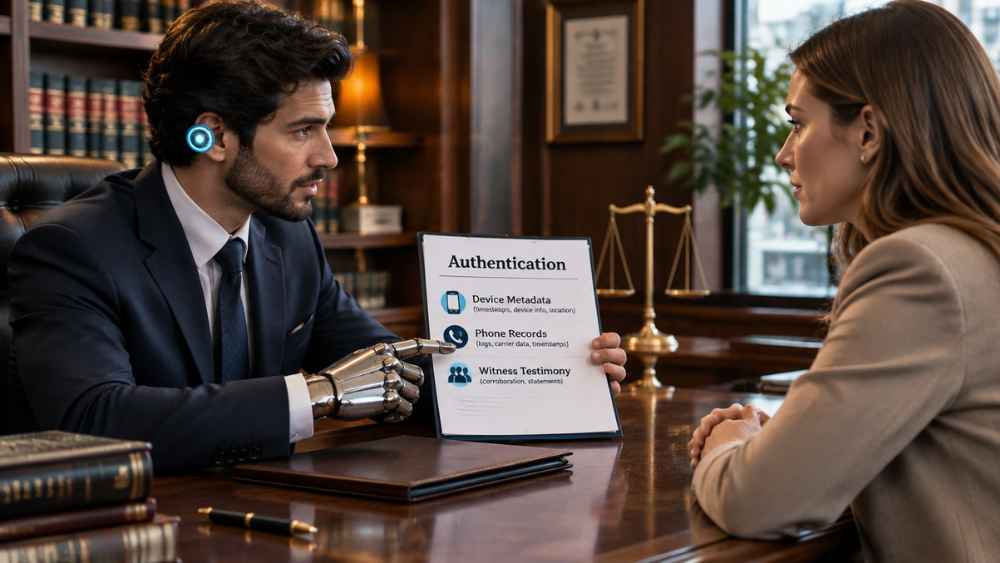
“The proponent established Authentication for the text messages through phone records, distinctive content, witness testimony, and device metadata.”
What Is Authentication in Evidence Law?
AuthenticationAdmissible EvidenceAdmissible Evidence is evidence a court permits the judge or jury to consider. In federal court, admissibility commonly depends on relevance, Rule 403 balancing, authentication, foundation, hearsay rules, privilege, witness competence, and other...View definition is the process of showing that an item of evidence is what the proponent claims it is.
Federal Rule of Evidence 901 supplies the general standard.
Therefore, authentication is a foundational requirement for many exhibits. See Federal Rule of Evidence 901.
Standard Authentication — Sample Contract Language
Phone records, distinctive details, and witness testimonyDirect ExaminationDirect Examination is questioning of a witness by the party that called the witness. It generally uses nonleading questions to establish personal knowledge, foundation, facts, exhibits, and expert opinions before cross-examination.View definition connect the messages to the defendantCivil CourtCivil court is a general term for a court handling noncriminal disputes involving people, businesses, organizations, or government entities. Civil cases can involve contracts, injuries, property, employment, civil rights, and other disputes and...View definition .
What Does Rule 901 Require?
The proponent must produce evidence sufficient to support a finding that the item is what the proponent claims.
The threshold is foundational rather than final proof of truth.
Therefore, the juryJuryA Jury is a group of citizens selected to perform a legal factfinding or charging function. Petit juries decide facts and return verdicts in trials, while grand juries determine whether probable cause supports...View definition can still dispute authenticity after admissionDirect EvidenceDirect Evidence proves a fact without requiring an additional inference about that fact. Examples can include eyewitness testimony, admissions, recordings, photographs, contracts, and other evidence that directly addresses the disputed issue.View definition .
Is Authentication the Same as Admissibility?
No. Authentication satisfies only one evidentiary requirement.
Hearsay, relevanceRelevanceRelevance asks whether evidence tends to make a consequential fact more or less probable. Federal Rules 401 and 402 establish the basic threshold, while Rule 403 permits exclusion when specified dangers substantially outweigh probative value.View definition , privilege, Rule 403, and other rules can still exclude the item.
Therefore, an authenticated exhibit is not automatically admissible.
Who Decides Authentication?
Rule 104(b) treats many authentication questions as conditional relevance issues.
The judgeJudgeA Judge is a judicial officer who presides over legal proceedings, applies law, manages procedure, rules on motions and evidence, and issues orders or judgments. Trial, appellate, Article III, magistrate, bankruptcy, and state...View definition decides whether enough evidence exists for a reasonable factfinderBench TrialA bench trial is a trial without a jury in which the judge decides disputed facts and applies the law. Strategy often focuses on precise proof, findings of fact, legal elements, and a...View definition to find authenticity.
Therefore, the ultimate factual dispute can remain for the jury.
Can a Witness Authenticate Evidence?
Yes. A witness with personal knowledge can testify that an item is what it is claimed to be.
Rule 901(b)(1) expressly recognizes this method.
Therefore, firsthand testimony is a common foundation.
Can Handwriting Be Authenticated?
Yes. A nonexpert familiar with handwriting outside the litigationLegal DisputeA legal dispute is a disagreement or controversy involving claimed legal rights, duties, liabilities, property, or remedies. It can be resolved through negotiation, mediation, arbitration, administrative proceedings, litigation, or settlement depending on the...View definition can identify it.
An expert or factfinder can also compare it with an authenticated specimen.
Therefore, multiple authentication methods exist.
What Are Distinctive Characteristics?
Rule 901Chain of CustodyChain of Custody is the documented history showing who collected, handled, transferred, stored, tested, and preserved evidence. It supports authentication and integrity, especially for fungible, biological, forensic, and digital evidence, while serious gaps...View definition allows authentication through appearance, contents, substance, internal patterns, and surrounding circumstances.
Unique knowledge or communication patterns can help.
Therefore, content itself can support identity.
Can a Voice Be Authenticated?
Yes. A witness can identify a voice after hearing it under circumstances connecting it with the speaker.
Familiarity can arise before or after the recorded statement.
Therefore, voice evidence does not always require an expert.
How Are Telephone Calls Authenticated?
Rule 901 provides methods for authenticating calls to assigned personal or business numbers.
Circumstances must support the claimed identity or business connection.
Therefore, self-identification alone can be insufficient.
How Are Public Records Authenticated?
Evidence can show that a document was lawfully recorded or filed in a public office.
It can also show that a record came from the office where such records are kept.
Therefore, official custody can establish foundation.
What Is the Ancient-Document Authentication Rule?
Rule 901 permits authentication of a document or data compilation at least 20 years old under specified conditions.
The item must be found where authentic material would likely be kept.
Therefore, age alone is not enough.
How Are Processes or Systems Authenticated?
Rule 901(b)(9) allows evidence describing a process or system and showing that it produces an accurate result.
This method is important for digital systems.
Therefore, technical foundation can establish machine-generated evidence.
What Is Self-Authentication?
Self-authentication means specified evidence requires no extrinsic authentication evidence before admission.
Federal Rule 902 lists qualifying categories.
Therefore, self-authentication eliminates one foundation step but not other evidentiary rules. See Federal Rule of Evidence 902.
What Public Documents Are Self-Authenticating?
Rule 902 covers specified domestic public documents that are sealed, signed, or certified.
Certified copies of public records can also qualify.
Therefore, official certification can replace live authentication testimony.
Are Newspapers and Periodicals Self-Authenticating?
Yes. Printed material purporting to be a newspaper or periodical falls within Rule 902.
Other objections can still apply.
Therefore, authentication does not resolve hearsay or relevance.
Are Trade Inscriptions Self-Authenticating?
Rule 902 covers inscriptions, signs, tags, and labels indicating origin, ownership, or control.
Commercial markings can therefore require no outside authentication witness.
Therefore, product labels can carry built-in foundation.
Are Acknowledged Documents Self-Authenticating?
Documents accompanied by a lawful acknowledgmentNotary PublicA notary public is a state-commissioned official who verifies identity and performs authorized notarial acts such as acknowledgments, jurats, and oaths.View definition from a notary or authorized officer can qualify under Rule 902.
The rule concerns authentication rather than substantive validity.
Therefore, notarization can simplify foundation.
Can Business Records Be Self-Authenticated?
Yes. Rules 902(11) and 902(12) permit certified domestic and foreign business recordsDocumentary EvidenceDocumentary evidence includes paper and electronic records offered in court. Its admissibility commonly depends on relevance, authentication, hearsay rules, and the Federal Rules governing writings, recordings, and photographs.View definition in qualifying circumstances.
The certification works with the Rule 803(6)Business Records ExceptionThe business records exception permits qualifying regularly maintained records to be admitted despite hearsay when Rule 803(6) requirements and a proper foundation are satisfied.View definition hearsay exceptionHearsay ExceptionA hearsay exception allows certain out-of-court statements to be admitted for their truth when the requirements of Rules 803, 804, 807, or another governing rule are satisfied.View definition .
Therefore, live custodian testimony is not always necessary.
What Is Rule 902(13)?
Rule 902(13)Digital EvidenceDigital Evidence is electronically stored, transmitted, or generated information offered to prove a fact. Emails, texts, video, photographs, metadata, logs, cloud data, and device records can be evidence, but relevance, authentication, hearsay, integrity,...View definition covers records generated by an electronic process or system when properly certified.
The certification must satisfy the Rule’s requirements.
Therefore, certain system-generated records can be self-authenticated.
What Is Rule 902(14)?
Rule 902(14) covers data copied from an electronic device, storage medium, or file through digital identification.
Hash values are a common method.
Therefore, forensic copies can often use certification instead of live testimony.
What Is a Hash Value?
A hash value is a mathematical digital fingerprint calculated from data.
Matching hashes can support a claim that two digital copies are identical.
Therefore, hashes are useful for authenticity and integrity.
Can Email Be Authenticated?
Yes. Email can be authenticated through witness knowledge, headers, addresses, content, replyMotionA Motion is a formal request asking a court to issue an order or grant specific relief. Federal Rule 7(b) generally requires motions to state their grounds with particularity and identify the relief...View definition patterns, metadataRequest for ProductionA Request for Production is a civil discovery request for documents, electronically stored information, tangible things, or inspection access. In federal court, Rule 34 governs requests to parties and sets requirements for particularity,...View definition , or surrounding circumstances.
No single method is mandatory.
Therefore, strong foundations often combine several indicators.
Can Text Messages Be Authenticated?
Yes. Phone records, witness testimony, message content, account information, device data, and context can establish identity.
A displayed contact name alone can be weak proof.
Therefore, attribution should be supported by surrounding evidence.
Can Social Media Be Authenticated?
Yes. Account data, distinctive content, witnesses, platform records, metadata, and circumstantial evidenceCircumstantial EvidenceCircumstantial Evidence is indirect proof that supports a fact through one or more reasonable inferences. It can prove intent, discrimination, negligence, causation, knowledge, possession, fraud, and other issues, and it is not inherently...View definition can support authentication.
Impersonation concerns can affect the foundation.
Therefore, account ownership should not be assumed from a username alone.
Can Photographs Be Authenticated?
Yes. A witness can testify that a photograph fairly depicts a scene the witness observed.
Automated photographs can use process or system evidence.
Therefore, the photographer does not always need to testify.
Can Video Be Authenticated?
Yes. Video can be authenticated through witness knowledge, system operation, metadata, timestamps, or chain-of-custody evidence.
Editing disputes can affect weight or admissibility.
Therefore, original files should be preserved when practical.
Can Audio Recordings Be Authenticated?
Yes. Voice identification, recording-system evidence, metadata, and surrounding circumstances can establish foundation.
Completeness and alteration can remain disputed.
Therefore, authentication and reliability are related but distinct.
What Is Chain of Custody?
Chain of custody documents possession, transfer, storage, and handling of evidence.
It is especially useful for fungible or digital items.
Therefore, chain records help show that the item has not materially changed.
Does a Chain-of-Custody Gap Automatically Exclude Evidence?
Not always. Courts can treat some gaps as affecting weight rather than admissibility.
The seriousness of the gap depends on circumstances.
Therefore, the proponent should still document custody carefully.
Authentication vs. Best Evidence Rule
Authentication asks whether an item is what the proponent claims.
The Best Evidence RuleBest Evidence RuleThe Best Evidence Rule generally requires an original writing, recording, or photograph when a party seeks to prove its content. Federal Evidence Rules 1001–1008 define originals and duplicates, permit reliable copies, and provide...View definition addresses proof of the contents of writings, recordings, and photographs.
Therefore, the doctrines solve different evidentiary problems.
Authentication vs. Hearsay
Authentication identifies the source or genuineness of evidence.
Hearsay rules address out-of-court statements offered for their truth.
Therefore, a genuine document can still contain inadmissible hearsay.
Authentication Example
Suppose a party offers text messages from the defendant.
Phone records, distinctive details, and witness testimony connect the messages to the defendant.
Therefore, the court can find sufficient Rule 901 authentication.
Why Does Authentication Matter?
Authentication protects the factfinding process from evidence that lacks a sufficient connection to its claimed source.
Modern rules allow flexible methods for both physical and digital evidence.
Therefore, lawyers should match the foundation to the evidence type.