
Chancery Court
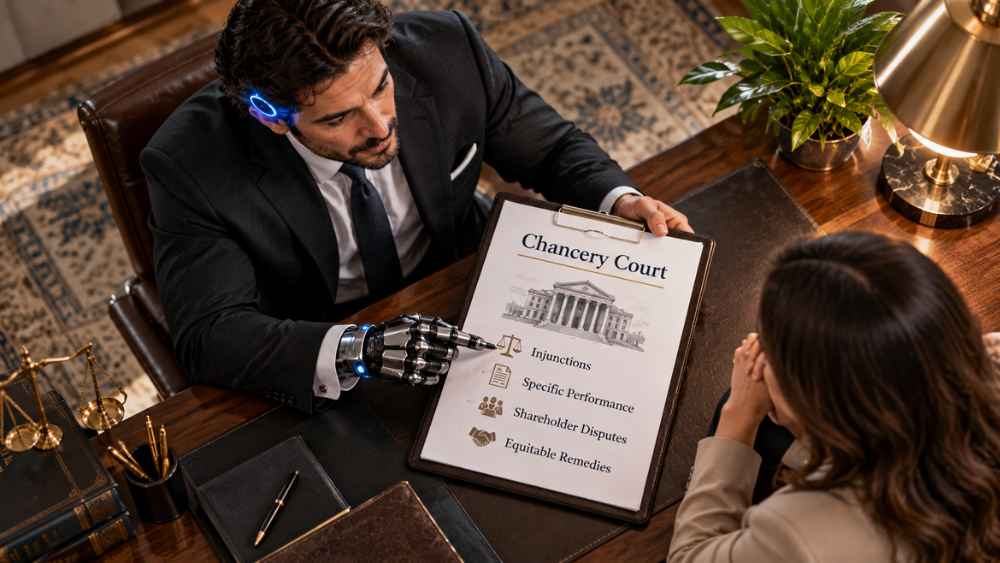
“The shareholders filed in Chancery Court seeking an injunction and specific performance rather than only monetary damages.”
What Is a Chancery Court?
A Chancery Court is a court historically associated with equityEquitable ReliefEquitable relief consists of nonmonetary or restorative remedies such as injunctions, specific performance, rescission, and reformation when legal remedies are inadequate.View definition rather than ordinary legal remedies.
Equity allows remedies such as injunctions, specific performanceBreach of ContractA breach of contract occurs when a party fails to perform an obligation required by an enforceable agreement. Examples include nonpayment, missed deadlines, defective performance, refusal to perform, or violation of another contract...View definition , rescissionLegal RemedyA legal remedy is the relief a court or other authorized tribunal can provide after a legal right has been violated. Remedies can include damages, injunctions, restitution, specific performance, rescission, declarations, and other...View definition , and other court-ordered relief.
Therefore, chancery jurisdictionLegal DisputeA legal dispute is a disagreement or controversy involving claimed legal rights, duties, liabilities, property, or remedies. It can be resolved through negotiation, mediation, arbitration, administrative proceedings, litigation, or settlement depending on the...View definition traditionally focuses on fairness-based remedies when money damages are inadequate.
Standard Chancery Court — Sample Contract Language
Suppose shareholdersCorporation DefinitionA corporation is a legal entity created under state law that is separate from its owners, usually called shareholders. It can own property, enter contracts, incur debts, sue or be sued, and operate...View definition allege that directorsBoard of DirectorsA board of directors is the governing body of a corporation responsible for major oversight and decisions, including management supervision, strategic matters, significant transactions, and fiduciary governance.View definition breached fiduciary dutiesGeneral PartnershipA General Partnership is a business relationship in which two or more persons carry on a business as co-owners. It can arise without formal entity filing, while state law governs authority, fiduciary duties,...View definition during a mergerMergerA merger is a corporate transaction combining entities under statute so that one survives or a new entity results, with assets and liabilities transferring according to law.View definition .
Where Did Chancery Courts Come From?
Chancery developed in England as a separate system of equity administered by the Lord Chancellor.
Therefore, it provided remedies when common-law courts could not offerOffer and AcceptanceOffer and Acceptance describes how parties manifest mutual assent to a contract. A valid offer gives another party power to accept, while acceptance must objectively communicate assent through an authorized method, subject to...View definition adequate relief.
See Cornell LII’s chancery overview.
What Is Equity?
Equity is a body of legal principles and remedies historically separate from common lawCommon LawCommon law is law developed through judicial decisions rather than created only through statutes or regulations. Courts use precedent to apply and refine common-law rules, although legislatures can modify or replace those rules.View definition .
Equitable reliefInjunctive ReliefInjunctive relief is an equitable remedy ordering a party to act or stop acting when monetary damages would be inadequate to prevent or remedy the harm.View definition often requires a party to act, stop acting, or restore a legal relationship.
See Cornell LII’s equity overview.
Chancery Court vs. Court of Law
A traditional court of law primarily awarded money damages.
A chancery court traditionally granted equitable remedies.
Therefore, the distinction concerns both procedure and available relief.
Do Chancery Courts Still Exist?
Yes, although most American court systems merged law and equity.
However, a few states still maintain courts or divisions with distinct chancery functions.
Therefore, the term has different modern meanings depending on jurisdiction.
Why Did Law and Equity Merge?
Modern procedural systems generally allow one court to grant both legal and equitable relief.
Federal courts merged law and equity procedure under the Federal Rules of Civil Procedure.
Therefore, separate chancery courts are now unusual.
What Is a Court of Equity?
A court of equityEquityEquity is the body of doctrines and remedies historically used when ordinary legal remedies are inadequate, including injunctions, specific performance, rescission, and other discretionary relief.View definition has authority to grant remedies beyond ordinary money damages.
Examples include injunctions, specific performance, rescission, and equitable accounting.
See Cornell LII’s court of equity overview.
What Is a Chancellor?
A chancellor is a judgeJudgeA Judge is a judicial officer who presides over legal proceedings, applies law, manages procedure, rules on motions and evidence, and issues orders or judgments. Trial, appellate, Article III, magistrate, bankruptcy, and state...View definition associated with a chancery court.
The title reflects the historical role of the English Lord Chancellor.
Therefore, some modern equity judges still use the title.
What Remedies Can a Chancery Court Grant?
Available remedies depend on the court’s jurisdiction and governing lawBoilerplate ClauseA boilerplate clause is standardized contract language addressing recurring legal mechanics such as notice, assignment, governing law, waiver, severability, and integration.View definition .
- Injunctions.
- Specific performance.
- Rescission.
- Reformation.
- Equitable accounting.
- Constructive trusts.
- Declaratory relief where authorized.
Therefore, chancery remedies can be highly flexible.
What Is an Injunction?
An injunctionCease and Desist LetterA cease and desist letter is a written demand asking a person or business to stop specified allegedly unlawful or harmful conduct. It is generally not a court order, but it can provide...View definition orders a party to do or stop doing something.
Courts generally require equitable standards such as irreparable harmTemporary Restraining OrderA Temporary Restraining Order is short-term emergency injunctive relief intended to prevent immediate harm until a court can consider longer-lasting relief. Federal TROs are governed by Rule 65’s notice, duration, and procedural requirements.View definition and inadequate legal remedies.
Therefore, injunctions are classic chancery relief.
What Is Specific Performance?
Specific performance orders a party to perform a contractual obligation.
It is often associated with unique propertySpecific PerformanceSpecific Performance is an equitable remedy ordering contractual performance when money damages are inadequate. It commonly arises with unique real estate or goods and depends on an enforceable agreement, fairness, feasibility, and equitable...View definition or agreements where money cannot provide adequate relief.
Therefore, real estate disputes frequently involve this remedyCause of ActionA Cause of Action is a recognized set of legal elements supporting a right to judicial relief. Its elements can arise from statutes, constitutions, regulations, or case law, and the claimant generally must...View definition .
What Is Rescission?
Rescission unwinds a transaction and attempts to restore the parties to their earlier positions.
Fraud, mistake, or other equitable grounds can support rescission.
Therefore, rescission differs from ordinary damages.
What Is Reformation?
Reformation changes a written instrument so it reflects the parties’ actual agreement under qualifying circumstances.
Mutual mistakeMutual MistakeMutual mistake occurs when both contracting parties share the same material erroneous belief about a basic assumption, potentially making the contract voidable when risk was not allocated to the affected party.View definition is a common example.
Therefore, reformation corrects documents rather than awarding compensation.
What Is a Constructive Trust?
A constructive trust is an equitable remedy that treats property as held for another person.
Courts can use it to prevent unjust retentionUnjust EnrichmentUnjust Enrichment requires restitution when a person retains a benefit that would be inequitable to keep without payment or return. Elements vary by jurisdiction, and a valid contract governing the same subject often...View definition of property.
Therefore, the remedy focuses on specific assets.
What Is an Equitable Accounting?
An equitable accounting can require detailed examination of financial dealings where ordinary damages proof is inadequate.
Fiduciary and partnershipBusiness FormationBusiness formation is the legal process of creating and organizing a business entity. It can involve choosing a structure, filing state documents, establishing governance, documenting ownership, obtaining tax identifiers, reviewing licenses, and planning...View definition disputes can involve accounting claims.
Therefore, chancery courts often handle complex financial relationships.
What Is the Delaware Court of Chancery?
The Delaware Court of Chancery is a prominent state courtState CourtA state court is a court established under a state constitution and state law. State courts hear the vast majority of U.S. civil and criminal cases, and their structures, names, procedural rules, and...View definition with original equity jurisdiction.
Its docket includes corporate, fiduciary, trust, real-estate, and commercial disputes.
See Delaware Court of Chancery jurisdiction information.
Why Is Delaware Chancery Important?
Many corporations are formed in Delaware.
The Court of Chancery therefore hears major disputes involving directors, officers, shareholders, mergers, and fiduciary duties.
Therefore, its corporate decisions are influential nationwide.
Is the Delaware Court of Chancery a Trial Court?
Yes. It is a trial courtTrial CourtA Trial Court is a court where parties present evidence, establish facts, and obtain an initial judgment or verdict. Federal district courts are the primary federal trial courts, while state systems use varied...View definition court of equityEquityEquity is the body of doctrines and remedies historically used when ordinary legal remedies are inadequate, including injunctions, specific performance, rescission, and other discretionary relief.View definition .
It develops factual records, hears witnesses, resolves motions, and enters judgments or decrees.
Therefore, appeals ordinarily follow trial-level proceedings.
Does Delaware Chancery Use Juries?
The Delaware Court of Chancery is generally a non-jury court.
Its judges decide both factual and legal issues within chancery jurisdiction.
Therefore, chancery litigation often resembles a bench trial.
What Corporate Cases Does Chancery Hear?
Corporate chancery cases can involve fiduciary duties, mergers, voting rightsShareholderA shareholder is a person or entity that owns stock in a corporation. Rights can include voting, distributions, information access, and litigation rights depending on the shares and governing law.View definition , books and records, and governance disputes.
Statutory jurisdiction can supplement traditional equity authority.
Therefore, corporate law is a major part of modern Delaware chancery practice.
What Is a Fiduciary Duty Case?
A fiduciary duty case alleges misuse of duties such as loyalty, care, or good faithBusiness Judgment RuleThe Business Judgment Rule is a judicial presumption protecting qualifying corporate decisions from hindsight review. Its application varies by jurisdiction but commonly depends on informed decision-making, disinterest, independence, good faith, and compliance with...View definition .
Directors, officers, trustees, and other fiduciaries can face such claims.
Therefore, equitable remedies can be important in fiduciary disputes.
Can Chancery Courts Hear Contract Cases?
Yes, when equitable relief or statutory jurisdiction supports the case.
For example, a party can seek specific performance of a merger or real-estate agreement.
Therefore, contract claims can belong in chancery when money is not enough.
Can Chancery Courts Award Money?
Sometimes. A court of equity can award monetary relief that is incidental or authorized by statuteStatutory LawStatutory law is written law enacted by a legislative body through the formal lawmaking process. Federal and state statutes can create rights, duties, prohibitions, causes of action, procedures, penalties, and remedies, and courts...View definition .
The exact authority depends on jurisdiction.
Therefore, chancery should not be understood as categorically unable to award money.
What Is the Clean-Up Doctrine?
The clean-up doctrine can allow an equity court to resolve related legal claims once equitable jurisdiction properly attaches.
The doctrine varies by state.
Therefore, a chancery court can sometimes decide an entire controversy.
What Is Inadequacy of Legal Remedies?
Equitable relief often requires showing that ordinary money damages cannot adequately solve the problem.
Unique property or continuing misconduct can support that showing.
Therefore, remedy adequacyClass Action LawsuitA class action lawsuit is a case where one or more representatives pursue claims for a larger group with similar legal issues. In federal court, class treatment generally requires certification under Rule 23.View definition is central to many chancery cases.
What Is Irreparable Harm?
Irreparable harm is injury that money damages cannot adequately repair.
It is commonly required for preliminary injunctive relief.
Therefore, timing and remedy adequacy often work together.
What Is a Preliminary Injunction?
A preliminary injunction preserves rights before final judgment.
Courts apply jurisdiction-specific equitable factors.
Therefore, a plaintiffCivil CourtCivil court is a general term for a court handling noncriminal disputes involving people, businesses, organizations, or government entities. Civil cases can involve contracts, injuries, property, employment, civil rights, and other disputes and...View definition usually must make a strong early evidentiary showing.
What Is a Temporary Restraining Order?
A temporary restraining order provides short-term emergency reliefEx ParteEx Parte refers to a one-sided request, proceeding, or communication. Courts permit ex parte relief only in authorized circumstances, while professional-conduct rules generally bar private communications with judges unless law or court order...View definition while the court considers further proceedings.
Rules and notice requirements vary.
Therefore, TRO practice can be an important chancery tool.
Can Chancery Courts Handle Trusts?
Yes. Trust administration and fiduciary disputes are traditional equity matters.
Courts can interpret trust instruments and supervise trustees.
Therefore, trust litigation often fits chancery jurisdiction.
Can Chancery Courts Handle Estates?
Some chancery courts have probateProbate CourtProbate court is a state court, or a division of a state court, that handles estates and related matters after death. It can validate wills, appoint personal representatives, supervise administration, resolve creditor and...View definition or estate jurisdiction under state law.
Other states assign probate to separate courts.
Therefore, the court’s statutory jurisdiction must be checked.
Can Chancery Courts Handle Family Law?
Some states give chancery courts jurisdiction over divorce, custody, support, adoption, or guardianshipLegal GuardianA legal guardian is a court-appointed fiduciary authorized to make specified decisions for a minor or incapacitated adult under state guardianship law.View definition matters.
Other states use family or circuit courts.
Therefore, “chancery” does not describe one national subject-matter list.
Can Chancery Courts Handle Real Estate Disputes?
Yes. Equity traditionally handles title, boundary, partition, and specific-performance disputes involving land.
However, state statutesPrimary AuthorityPrimary Authority is law issued by an institution with official power to create or state legal rules. Constitutions, statutes, regulations, court decisions, and court rules can be primary authority, while binding effect depends...View definition can expand or limit jurisdiction.
Therefore, property cases remain closely associated with chancery.
Chancery Court vs. Circuit Court
The distinction depends on the state.
Historically, circuit courts handled law while chancery courts handled equity.
Therefore, modern state statutes determine whether jurisdiction overlaps.
Chancery Court vs. Superior Court
A superior courtSuperior CourtSuperior Court is a name used by some states for a trial court with broad or general jurisdiction. Its exact authority varies by state and can include civil, criminal, family, probate, juvenile, and...View definition often exercises broad trialLawsuitA lawsuit is a legal dispute brought before a court for a decision or remedy. Civil lawsuits can involve pleadings, service, discovery, motions, settlement, trial, judgment, and possible appeal.View definition jurisdiction.
A chancery court can have specialized equity jurisdiction.
Therefore, the names reflect different structures rather than a universal hierarchy.
Chancery Court vs. Probate Court
A probate court focuses on estates, wills, and related matters.
A chancery court can handle probate in some jurisdictions but not others.
Therefore, local lawOrdinanceAn Ordinance is a law enacted by a municipality or other authorized local government. Local authority depends on state constitutions, statutes, charters, home-rule rules, Dillon’s Rule principles, and preemption, while ordinances commonly govern...View definition controls the overlap.
What Is Concurrent Jurisdiction?
Concurrent jurisdictionJurisdiction DefinitionJurisdiction is a court’s legal authority to hear a case, issue orders, and bind the parties. Courts may need subject matter jurisdiction over the type of dispute and personal jurisdiction over the defendant...View definition exists when more than one court can hear the same category of dispute.
Some states give chancery and circuit courts overlapping civil jurisdiction.
Therefore, filing strategy can depend on requested remedies.
What Is Exclusive Equity Jurisdiction?
Exclusive equity jurisdiction means a particular court alone hears specified equitable matters.
The Delaware Court of Chancery is a prominent example.
Therefore, subject-matter jurisdiction should be reviewed before filing.
How Does Discovery Work in Chancery?
Chancery litigation can use document requests, interrogatoriesDiscovery DefinitionDiscovery is the pretrial process for exchanging information and evidence in a lawsuit. Common discovery tools include document requests, interrogatories, requests for admission, depositions, subpoenas, and expert disclosures.View definition , depositions, subpoenas, and expert discovery.
Procedural rules vary by court.
Therefore, equity cases can involve extensive modern discovery.
How Does a Chancery Trial Work?
Many chancery trials are benchBenchThe bench is the judge's raised courtroom desk and is also a common legal term for a judge, group of judges, or the judiciary.View definition trials before a chancellor or equity judge.
The court hears evidence and makes factual findings.
Therefore, witness credibilityWitness CredibilityWitness credibility is the factfinder's assessment of whether testimony is believable and what weight it deserves, informed by admissible evidence concerning consistency, bias, perception, memory, and truthfulness.View definition and documentary evidenceDirect EvidenceDirect Evidence proves a fact without requiring an additional inference about that fact. Examples can include eyewitness testimony, admissions, recordings, photographs, contracts, and other evidence that directly addresses the disputed issue.View definition remain important.
Can Chancery Decisions Be Appealed?
Yes. Appeals go through the appellate structure established by the jurisdiction.
For Delaware Chancery, appeals generally go to the Delaware Supreme CourtSupreme CourtThe Supreme Court of the United States is the nation’s highest federal court. It reviews selected cases involving the Constitution and federal law, resolves important federal legal questions, and sits at the top...View definition .
Therefore, trial records and issue preservation matter.
What Is a Chancery Decree?
A decree is a traditional term for an equity court’s order resolving rights and remedies.
Modern courts often use the word judgmentCivil LawsuitA civil lawsuit is a noncriminal court action in which a plaintiff seeks a legal remedy from a defendant. The process can include jurisdiction, pleadings, service, discovery, motions, settlement, trial, judgment, enforcement, and...View definition instead.
Therefore, decree and judgment can overlap in current practice.
Chancery Court Example
Suppose shareholders allege that directors breached fiduciary duties during a merger.
They seek an injunction and other equitable relief.
In Delaware, that dispute can fall within Court of Chancery jurisdiction.
Why Does Chancery Court Matter?
Chancery courts preserve the historical role of equity in modern litigation.
They can provide flexible remedies when money damages do not adequately protect legal rights.
The key questions are practical. Does the court have equity jurisdiction? What remedy is sought? Does a statute create specialized chancery authority?