
Superior Court
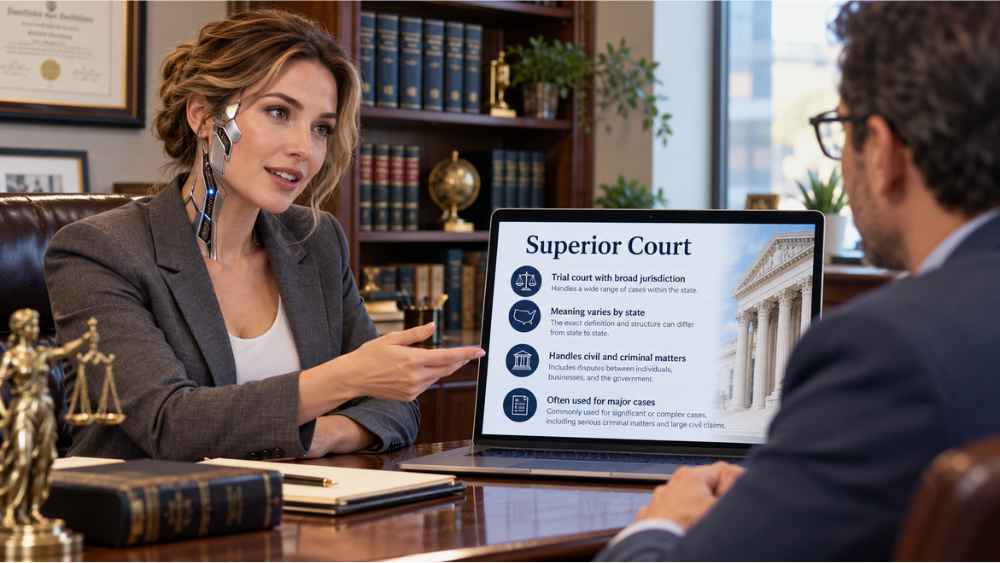
“The company filed its contract lawsuit in the county Superior Court, where the case proceeded through pleadings, discovery, motions, and trial preparation.”
What Is a Superior Court?
Superior Court is a name used by some states for a trial courtTrial CourtA Trial Court is a court where parties present evidence, establish facts, and obtain an initial judgment or verdict. Federal district courts are the primary federal trial courts, while state systems use varied...View definition with broad or general jurisdictionJurisdiction DefinitionJurisdiction is a court’s legal authority to hear a case, issue orders, and bind the parties. Courts may need subject matter jurisdiction over the type of dispute and personal jurisdiction over the defendant...View definition .
The exact meaning varies by state.
For example, California calls each county’s unified trial court a superior court. See the California Judicial Branch overview of Superior Courts.
Standard Superior Court — Sample Contract Language
Suppose a California business files a contract lawsuitLawsuitA lawsuit is a legal dispute brought before a court for a decision or remedy. Civil lawsuits can involve pleadings, service, discovery, motions, settlement, trial, judgment, and possible appeal.View definition against another company.
What Does a Superior Court Do?
A superior court can hear evidence, resolve factual disputes, apply law, and enter judgments.
Depending on the state, it can handle civil, criminal, family, probateProbate CourtProbate court is a state court, or a division of a state court, that handles estates and related matters after death. It can validate wills, appoint personal representatives, supervise administration, resolve creditor and...View definition , juvenile, or other cases.
Therefore, the court’s actual jurisdictionLegal DisputeA legal dispute is a disagreement or controversy involving claimed legal rights, duties, liabilities, property, or remedies. It can be resolved through negotiation, mediation, arbitration, administrative proceedings, litigation, or settlement depending on the...View definition must be checked under state law.
Is Superior Court a Federal Court?
No. The term Superior Court usually refers to a state or local trial court.
Federal trial courts are called United States district courts.
Therefore, a Superior Court filing generally follows state procedural rules.
Is Superior Court the Same in Every State?
No. States use different names and structures for trial courts.
Some states use Superior Court, while others use Circuit CourtCourt of AppealsA court of appeals is a court that reviews decisions from lower courts. Federal courts of appeals usually examine the existing record for legal error rather than conducting a new trial or hearing...View definition , District CourtDistrict CourtA U.S. district court is the primary trial court in the federal court system. District courts hear qualifying federal civil and criminal cases, decide motions, conduct trials, and enter judgments that may later...View definition , or Court of Common PleasCourt of Common PleasA Court of Common Pleas is a state trial court name used in several jurisdictions; its exact jurisdiction depends on state law and local court structure.View definition .
Therefore, the title cannot be interpreted without identifying the state.
What Is General Jurisdiction?
General jurisdiction means a court can hear a broad range of case types unless law assigns a matter elsewhere.
For example, California superior courts are courts of general jurisdiction.
Therefore, they handle many disputes beyond specialized limited-jurisdiction matters.
What Is Limited Jurisdiction?
Limited jurisdictionFederal CourtA federal court is a court within the U.S. federal judicial system. Federal courts have limited jurisdiction, so they hear only cases authorized by the Constitution or federal law, including many federal-question and...View definition means a court can hear only specified categories or amounts.
Some states separate limited-jurisdiction courts from superior courts.
Other states handle limited matters within one unified trial court.
What Cases Can Superior Court Hear?
The answerCivil LitigationCivil Litigation is the court process for resolving noncriminal disputes through pleadings, motions, discovery, settlement, trial, judgment, and possible appeal. Federal civil litigation follows the Federal Rules of Civil Procedure, while state systems...View definition depends on state law.
Common categories can include civil lawsuits, felony prosecutions, family matters, probate, juvenile cases, and appeals from lower courts.
Therefore, court websites and statutesPrimary AuthorityPrimary Authority is law issued by an institution with official power to create or state legal rules. Constitutions, statutes, regulations, court decisions, and court rules can be primary authority, while binding effect depends...View definition should be checked before filing.
Does Superior Court Hear Civil Cases?
Yes, in states where Superior Court has civil jurisdictionCivil CourtCivil court is a general term for a court handling noncriminal disputes involving people, businesses, organizations, or government entities. Civil cases can involve contracts, injuries, property, employment, civil rights, and other disputes and...View definition .
For example, a business can file a contract or tort lawsuit there.
However, monetary thresholds or specialized assignments can affect the correct division.
Does Superior Court Hear Criminal Cases?
Many superior courts hear serious criminal cases.
For example, California superior courts hear felony and misdemeanor matters within the unified trial system.
However, state structures vary.
Does Superior Court Handle Family Law?
Some superior courts include family-law departments or divisions.
These can handle divorce, custody, support, and related matters.
Therefore, a separate courthouse division can exist within the same superior court.
Does Superior Court Handle Probate?
Some superior courts include probate departments.
For example, California superior courts handle probate matters.
Other states use separate probate or surrogate courts.
Does Superior Court Handle Juvenile Cases?
In some states, superior courts hear juvenile matters through specialized divisions.
Other states assign juvenile cases to separate courts.
Therefore, local structure controls.
What Is a Superior Court Judge?
A Superior Court judgeJudgeA Judge is a judicial officer who presides over legal proceedings, applies law, manages procedure, rules on motions and evidence, and issues orders or judgments. Trial, appellate, Article III, magistrate, bankruptcy, and state...View definition is a state judicial officer serving on a court bearing that name.
Selection methods can include election, appointment, or a mixed system.
Therefore, judicial selection varies by state.
What Is a Superior Court Complaint?
A complaintCivil LawsuitA civil lawsuit is a noncriminal court action in which a plaintiff seeks a legal remedy from a defendant. The process can include jurisdiction, pleadings, service, discovery, motions, settlement, trial, judgment, enforcement, and...View definition is a pleadingPleadingA pleading is a formal court document stating a party’s claims, defenses, or responses in a civil case. Federal Rules 7 and 8 identify permitted pleadings and govern claims, admissions, denials, affirmative defenses,...View definition that starts many civil casesCivil DivisionA Civil Division is a court unit handling noncriminal disputes, with jurisdiction and procedures that vary by court system and locality.View definition .
It identifies the parties, claims, factual allegations, and requested relief.
Therefore, filing requirements come from state procedural rules and local courtMunicipal CourtA Municipal Court is a local court whose authority is defined by state law, city law, or both. Many municipal courts have limited jurisdiction over traffic, misdemeanors, ordinances, protective orders, or smaller civil...View definition court rulesPrimary AuthorityPrimary Authority is law issued by an institution with official power to create or state legal rules. Constitutions, statutes, regulations, court decisions, and court rules can be primary authority, while binding effect depends...View definition .
What Is Service of Process?
Service of processAffidavit of ServiceAn affidavit of service is a sworn statement documenting how and when legal papers were served and can provide proof of notice for jurisdiction, deadlines, and court procedure.View definition gives a defendant legally required notice of the case.
The plaintiff must follow applicable state rules.
Therefore, improper service can delay or undermine the proceeding.
What Is an Answer?
An answer is a defendant’s responsive pleadingAnswer to ComplaintAn Answer to Complaint is the defendant’s formal pleading responding to a civil complaint. It typically admits or denies allegations, states insufficient knowledge where appropriate, asserts defenses, and can include counterclaims, jury demands,...View definition .
It can admit or deny allegations and assert defenses.
Therefore, the answer helps define disputed issues.
What Is Discovery in Superior Court?
Discovery is the pretrial exchange of relevant information and evidence.
It can include interrogatoriesDiscovery DefinitionDiscovery is the pretrial process for exchanging information and evidence in a lawsuit. Common discovery tools include document requests, interrogatories, requests for admission, depositions, subpoenas, and expert disclosures.View definition , document requests, admissions, depositions, and subpoenas.
However, state discovery rules can differ from federal rules.
Can Superior Court Issue Subpoenas?
Yes, when authorized by the court’s procedural rules.
A subpoena can require testimony or production of documents.
Therefore, subpoena procedures depend on the state and case.
Can Superior Court Grant Summary Judgment?
Yes, when state law provides a summary judgmentMotion to DismissA motion to dismiss asks a court to end all or part of a case because of a legal or procedural defect. In federal civil cases, Rule 12 lists grounds including jurisdiction, venue,...View definition procedure.
The moving party asks the court to resolve claims without trial under the applicable standard.
However, state standards and deadlines can differ from Federal Rule 56Summary JudgmentSummary judgment is a court ruling entered without a full trial when no genuine dispute exists over any material fact and the moving party is entitled to judgment as a matter of law....View definition .
Can Superior Court Issue Injunctions?
Yes, when the court has authority and equitable requirements are met.
For example, a party can seek emergency or permanent relief against threatened harm.
Therefore, superior courts can provide both monetary and equitable remediesChancery CourtA Chancery Court is a court historically associated with equity and remedies such as injunctions, specific performance, rescission, and reformation. Most U.S. courts merged law and equity, but some states still maintain distinct...View definition .
What Happens at a Superior Court Trial?
A trial presents admissible evidenceAdmissible EvidenceAdmissible Evidence is evidence a court permits the judge or jury to consider. In federal court, admissibility commonly depends on relevance, Rule 403 balancing, authentication, foundation, hearsay rules, privilege, witness competence, and other...View definition to a judge or juryJuryA Jury is a group of citizens selected to perform a legal factfinding or charging function. Petit juries decide facts and return verdicts in trials, while grand juries determine whether probable cause supports...View definition .
The parties can call witnesses, offerOffer and AcceptanceOffer and Acceptance describes how parties manifest mutual assent to a contract. A valid offer gives another party power to accept, while acceptance must objectively communicate assent through an authorized method, subject to...View definition exhibits, and present legal arguments.
Then the fact-finder resolves disputed facts under the applicable burden of proofBurden of ProductionThe burden of production requires a party to produce enough evidence on an issue for the issue to proceed to the factfinder rather than be resolved as a matter of law.View definition .
Can Superior Court Cases Have a Jury?
Yes, in qualifying cases where a jury right exists and is properly requested.
Other matters use a bench trial.
Therefore, the case type and state rules control.
What Is a Bench Trial?
A bench trial is a trial decided by a judge rather than a jury.
The judge determines both facts and law.
Therefore, some superior court cases never involve jurors.
What Is a Superior Court Judgment?
A judgment is the court’s formal resolution of claims and relief.
For example, the court can enter a money judgmentJudgmentA Judgment is a court's formal determination of rights and obligations in a civil action. Federal Rules 54 and 58 govern important aspects of judgment and entry, while final judgments affect appeals, post-trial...View definition after a civil trial.
Therefore, judgments create enforceable legal consequences.
Can a Superior Court Judgment Be Appealed?
Yes, many final judgments can be appealed.
The appeal goes to the state appellate courtState Supreme CourtA State Supreme Court is usually the highest court in a state's judicial system and the final authority on state-law questions. It commonly exercises discretionary appellate review, creates binding state precedent, and can...View definition identified by state law.
Therefore, the appellate route depends on the state system.
Superior Court vs. Supreme Court
A superior court is usually a trial court.
A state supreme court is usually the highest appellate court in that state.
Therefore, the word “superior” does not mean the court is above a state supreme court.
Superior Court vs. District Court
The comparison depends on the jurisdiction.
In the federal system, District Court means the principal federal trial courtFederal District CourtA Federal District Court is a United States trial court that hears federal civil and criminal cases within jurisdiction granted by Congress and the Constitution.View definition .
In some states, a district court is a state trial court with either broad or limited jurisdiction.
Superior Court vs. Circuit Court
Some states call their principal trial courts circuit courts rather than superior courts.
Both names can describe courts with broad trial jurisdiction.
However, the precise authority comes from state law.
Superior Court vs. Municipal Court
Historically, some states used municipal courts for lower-level matters and superior courts for broader jurisdiction.
Modern structures vary.
For example, California unified its municipal and superior courts into one superior court system.
Superior Court vs. Small Claims Court
Small claims is a simplified forum with limited monetary jurisdiction.
In some states, small claims operates as a division of a broader trial court.
Therefore, small claims can exist inside a superior court structure.
How Do You Find the Correct Superior Court?
The correct court can depend on jurisdiction, venue, case type, and county.
For example, a civil case may belong where the defendant resides or where events occurred.
Therefore, filing location should be confirmed before submission.
Are Superior Court Records Public?
Many superior court recordsClerk of CourtA Clerk of Court manages a court’s major nonjudicial functions, including dockets, records, filings, notices, fees, jury administration, and operational systems. The clerk supports judicial work but does not decide the merits of...View definition are public subject to sealing, privacy, and access rules.
Online access varies by state and county.
Therefore, official court websites are the best starting point.
Superior Court Example
Suppose a California business files a contract lawsuit against another company.
The case begins in the appropriate county Superior Court.
The court can manage pleadings, discovery, motions, trial, judgment, and postjudgment proceedings.
Why Does Superior Court Matter?
Superior courts serve as important state trial courts in jurisdictions that use that name.
However, their authority and structure vary.
The key questions are practical. Which state uses the term? What jurisdiction applies? Which division handles the case? Where is venue proper?