
Terms and Conditions
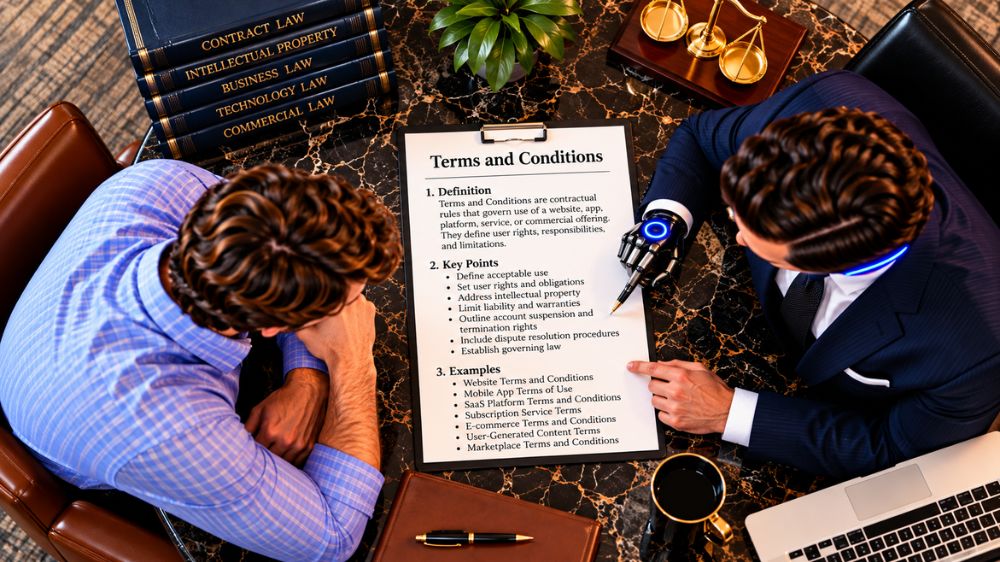
“The software company updated its Terms and Conditions to clarify subscription billing, acceptable use, intellectual property, liability limits, account suspension, and dispute procedures.”
What Are Terms and Conditions?
Terms and ConditionsTerms of ServiceTerms of Service are online contractual rules governing access to and use of a website, application, platform, or digital service.View definition are contractual rules that govern use of a website, app, platform, service, or commercial offering.
They can define user rights, payment obligations, acceptable conduct, intellectual property rightsIntellectual PropertyIntellectual property, or IP, is a group of legal rights that protect certain inventions, creative works, brands, and confidential business information. Major U.S. categories include patents, copyrights, trademarks, and trade secrets.View definition , disclaimers, and dispute procedures.
Therefore, Terms and Conditions can become an important part of the legal relationship between a business and its users.
Standard Terms and Conditions — Sample Contract Language
Its Terms and Conditions address accounts, subscriptions, acceptable use, IP, disclaimers, liability, suspension, and dispute procedures.
Are Terms and Conditions a Contract?
They can be. Enforceability usually depends on contract formationOffer and AcceptanceOffer and Acceptance describes how parties manifest mutual assent to a contract. A valid offer gives another party power to accept, while acceptance must objectively communicate assent through an authorized method, subject to...View definition principles such as notice and assent.
For example, a user who clearly agrees through a checkbox can be more likely to form a contract.
However, hidden or poorly presented terms can face enforceability problems.
What Is Clickwrap?
Clickwrap requires a user to take an affirmative action showing agreement to terms.
For example, a user can check a box stating agreement before creating an account.
Therefore, clickwrap can provide stronger evidence of assent.
What Is Browsewrap?
Browsewrap attempts to bind users through website use without requiring an affirmative acceptance action.
For example, terms can appear through a footer link while the site states that continued use means acceptance.
However, browsewrap can create notice and assent problems.
What Is Sign-In Wrap?
Sign-in wrap presents terms near a button used to create an account or complete a transaction.
The interface states that taking the action signifies agreement.
Therefore, design and notice remain important to enforceability.
What Should Terms and Conditions Include?
The exact contents depend on the business and service.
- Eligibility and account rules.
- Acceptable use.
- Payment and billing.
- Subscriptions and renewal.
- Cancellations and refunds.
- Intellectual property.
- User content.
- Privacy references.
- Disclaimers.
- Limitations of liability.
- IndemnificationMaster Service Agreement (MSA)A Master Service Agreement, or MSA, sets recurring legal and commercial terms for an ongoing service relationship. The parties can then use SOWs, order forms, or schedules for project-specific scope, pricing, deliverables, and...View definition .
- Termination and suspension.
- Dispute resolutionLegal DisputeA legal dispute is a disagreement or controversy involving claimed legal rights, duties, liabilities, property, or remedies. It can be resolved through negotiation, mediation, arbitration, administrative proceedings, litigation, or settlement depending on the...View definition .
- Governing lawBoilerplate ClauseA boilerplate clause is standardized contract language addressing recurring legal mechanics such as notice, assignment, governing law, waiver, severability, and integration.View definition .
- Changes to the terms.
Therefore, generic terms may not fit every product or business model.
What Is an Acceptable Use Policy?
An Acceptable Use Policy, or AUP, defines prohibited or restricted uses of a service.
For example, it can prohibit fraud, malware, harassmentEmployment LawEmployment law is the body of federal, state, and local law that governs relationships between employers and employees. It covers wages, discrimination, harassment, leave, safety, benefits, contracts, employee classification, union rights, and termination.View definition , unlawful content, or misuse of platform resources.
The AUP can appear inside the Terms and Conditions or as a separate document.
What Are Account Rules?
Account rules can define eligibility, registration, credentials, and user responsibilities.
For example, users can be required to maintain accurate information and protect passwords.
Therefore, account provisions help allocate security responsibilities.
How Do Payment Terms Work?
Payment terms can explain prices, taxes, billing cycles, payment methods, and consequences of nonpayment.
For example, a subscription service can bill monthly until cancellation.
Therefore, billing language should be clear before the user is charged.
What Is Automatic Renewal?
Automatic renewal extends a subscription unless the customer cancels under the stated process.
Federal and state laws can regulate renewal disclosures and cancellation practices.
Therefore, businesses should review current rules for the markets they serve.
What Is a Cancellation Policy?
A cancellation policy explains how a user can end a subscription, service, or order.
It can address timing, notice, access after cancellation, and future charges.
Therefore, cancellation terms should match the actual product workflow.
What Is a Refund Policy?
A refund policy explains when customers can receive refunds, credits, or other remedies.
For example, a business can provide refunds only within a stated period.
However, consumer-protection law can create additional rights.
What Are Intellectual Property Terms?
Intellectual property terms can explain ownership of the website, software, branding, content, and other materials.
For example, the company can grant users a limited license to access the service.
Therefore, the terms should distinguish ownership from permission to use.
What Is a User Content License?
A user content license gives the platform specified rights to host, display, process, or distribute user-submitted content.
For example, a social platform can need permission to display uploaded photos to other users.
Therefore, the license should match the service’s actual functions.
What Is a Copyright Complaint Procedure?
Online services can include procedures for reporting alleged copyright infringementCopyright InfringementCopyright infringement occurs when someone violates an exclusive copyright right without authorization or another valid legal basis. Claims can involve copying, derivative works, distribution, performance, display, or secondary liability, subject to defenses and...View definition .
For qualifying U.S. services, federal law can also provide a notice-and-takedown framework.
Therefore, platform terms often connect users to a separate copyright policy.
What Is a Disclaimer?
A disclaimerDisclaimerA disclaimer is language intended to limit or qualify warranties, representations, responsibility, reliance, or liability, subject to contract and statutory limits.View definition limits or clarifies warranties, representations, or expectations where law permits.
For example, software terms can state that the service is provided subject to specified warrantyWarrantyA warranty is an express or implied assurance concerning goods, services, property, or performance and can create contractual remedies when breached.View definition limitations.
However, disclaimers cannot override mandatory consumer protections.
What Is a Limitation of Liability?
A limitation of liability restricts certain damagesLegal RemedyA legal remedy is the relief a court or other authorized tribunal can provide after a legal right has been violated. Remedies can include damages, injunctions, restitution, specific performance, rescission, declarations, and other...View definition or sets a financial cap.
For example, the terms can cap liability at fees paid during a stated period.
However, enforceability depends on governing law and the surrounding transaction.
What Is an Indemnification Clause?
An indemnification clauseIndemnification ClauseAn indemnification clause allocates responsibility for specified claims, losses, liabilities, or expenses. It can require one party to indemnify, defend, or protect another party when defined events occur, subject to contractual procedures and...View definition can require a user to protect the business from specified third-party claims.
For example, a user can indemnify the platform for claims arising from unlawfully uploaded content.
Therefore, the clause should define covered claims and procedures.
What Is a Suspension Clause?
A suspension clause allows the business to restrict access in stated circumstances.
For example, fraud, security threats, or serious policy violations can trigger suspension.
Therefore, suspension rules should be tied to legitimate operational needs.
What Is a Termination Clause?
A termination clauseTermination ClauseA Termination Clause defines when and how parties can end a contract, including cause, convenience, notice, cure periods, fees, and effective dates. Strong clauses also address accrued payments, surviving obligations, confidentiality, data return,...View definition explains when the user or business can end the contractual relationship.
It can address account closure, outstanding fees, data access, and surviving obligations.
Therefore, termination language should explain what happens after access ends.
What Is an Arbitration Clause?
An arbitration clauseCommercial ArbitrationCommercial Arbitration is private, contract-based dispute resolution in which neutral arbitrators decide business disputes and issue enforceable awards.View definition requires qualifying disputes to be resolved through arbitrationAlternative Dispute ResolutionAlternative Dispute Resolution, or ADR, includes negotiation, mediation, arbitration, settlement conferences, and other processes used outside ordinary trial adjudication. Each method differs in neutrality, confidentiality, party control, binding effect, cost, and review.View definition rather than ordinary court litigation.
It can also address arbitration rules, location, fees, and procedures.
However, enforceability depends on applicable contract and arbitration law.
What Is a Class Action Waiver?
A class action waiver can require disputes to proceed individually rather than through class proceedings.
These clauses often appear with arbitration provisions.
However, enforceability can depend on governing law and the specific agreement.
What Is a Governing Law Clause?
A governing law clauseChoice of Law ClauseA Choice of Law Clause selects the jurisdiction's substantive law intended to govern a contract or dispute. Courts often honor reasonable governing-law provisions, but conflict-of-laws rules, mandatory statutes, public policy, clause scope, and...View definition identifies the law intended to govern the contract.
For example, the terms can select the law of a particular state.
However, mandatory consumer laws can still apply in some circumstances.
What Is a Forum Selection Clause?
A forum selection clauseForum Selection ClauseA forum selection clause identifies where contract disputes may be filed. Learn how exclusive courts, venue, jurisdiction, and governing law interact.View definition identifies the court or location for specified disputes.
For example, the clause can select state or federal courts in a named county.
Therefore, governing law and forum selection answerCivil LitigationCivil Litigation is the court process for resolving noncriminal disputes through pleadings, motions, discovery, settlement, trial, judgment, and possible appeal. Federal civil litigation follows the Federal Rules of Civil Procedure, while state systems...View definition different questions.
Terms and Conditions vs. Privacy Policy
Terms and Conditions govern the contractual relationship and use of the service.
A privacy policyPrivacy PolicyA Privacy Policy is a public statement explaining how an organization collects, uses, discloses, retains, protects, and otherwise handles personal information. Applicable privacy laws can require specific disclosures about purposes, rights, recipients, retention,...View definition explains how personal informationPersonally Identifiable Information (PII)Personally Identifiable Information (PII) is information that can distinguish or trace an individual’s identity alone or with other linked or linkable information. Common examples include identifiers, contact details, biometrics, financial information, health information,...View definition is collected, used, shared, and protected.
Therefore, the documents serve different legal functions.
Terms and Conditions vs. End User License Agreement
An End User License AgreementLicensing AgreementA Licensing Agreement is a contract granting permission to use specified property, technology, or intellectual property while the licensor generally retains ownership. Key terms commonly address scope, exclusivity, territory, term, royalties, sublicensing, quality...View definition , or EULASoftware License AgreementA Software License Agreement defines permitted software use, restrictions, license metrics, IP rights, warranties, liability, support, and termination.View definition , focuses on licensing software to an end user.
Terms and Conditions can cover a broader service relationship.
However, a digital product can use both documents or combine them.
Terms and Conditions vs. Terms of Service
Terms and Conditions and Terms of Service often refer to the same type of user agreement.
Businesses also use names such as Terms of UseWebsite Terms and ConditionsWebsite Terms and Conditions are online contractual rules governing access to and use of a website or digital service.View definition or User Agreement.
Therefore, substance matters more than the title.
Can Terms and Conditions Be Changed?
Terms can include procedures for future amendments.
However, businesses should provide appropriate notice and obtain renewed assent when required.
Therefore, simply posting a hidden change may create enforceability risk.
How Should Terms Be Presented?
Terms should be accessible before the user takes the action that creates the contract.
For example, a checkout page can provide a visible link next to an agreement checkbox.
Therefore, interface design can affect contract formation.
Can Minors Agree to Terms and Conditions?
Contract capacity rules can limit agreements with minors.
In addition, services directed to children can face separate privacy and consumer-protection requirements.
Therefore, age and eligibility provisions should match the service.
Terms and Conditions Example
Suppose a software company offers a paid online platform.
Its Terms and Conditions address accounts, subscriptions, acceptable use, IP, disclaimers, liability, suspension, and dispute procedures.
Users accept the terms through a clear clickwrap process during signup.
Why Do Terms and Conditions Matter?
Terms and Conditions define the rules for using a product or service.
However, good drafting alone is not enough if users never receive reasonable notice or provide valid assent.
The key questions are practical. What rules apply? How does the user agree? Which risks are allocated? Which mandatory laws limit the terms?