
Motion in Limine
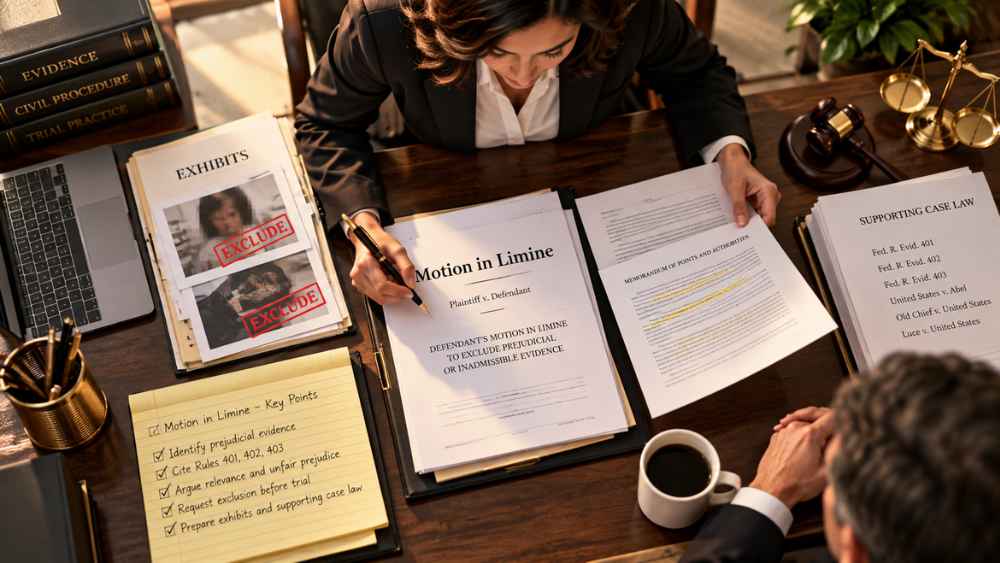
“Before trial, counsel filed a Motion in Limine asking the judge to exclude inflammatory photographs under Rules 401 and 403.”
What Is a Motion in Limine?
A Motion in LimineAdmissible EvidenceAdmissible Evidence is evidence a court permits the judge or jury to consider. In federal court, admissibility commonly depends on relevance, Rule 403 balancing, authentication, foundation, hearsay rules, privilege, witness competence, and other...View definition is a pretrial request for a ruling on evidence before it reaches the juryJuryA Jury is a group of citizens selected to perform a legal factfinding or charging function. Petit juries decide facts and return verdicts in trials, while grand juries determine whether probable cause supports...View definition .
It commonly seeks exclusion of prejudicial or inadmissible material.
Therefore, the motionMotionA Motion is a formal request asking a court to issue an order or grant specific relief. Federal Rule 7(b) generally requires motions to state their grounds with particularity and identify the relief...View definition addresses evidence at the threshold of trialLawsuitA lawsuit is a legal dispute brought before a court for a decision or remedy. Civil lawsuits can involve pleadings, service, discovery, motions, settlement, trial, judgment, and possible appeal.View definition . See Cornell LII’s Motion in Limine overview.
Standard Motion in Limine — Sample Contract Language
Suppose a defendantCivil CourtCivil court is a general term for a court handling noncriminal disputes involving people, businesses, organizations, or government entities. Civil cases can involve contracts, injuries, property, employment, civil rights, and other disputes and...View definition wants to exclude inflammatory photographs with minimal probative value.
What Does In Limine Mean?
In limine is Latin for “at the threshold.”
The phrase reflects a request made before the evidence is presented at trial.
Therefore, the ruling can prevent the jury from hearing improper material.
Can a Motion in Limine Seek Admission?
Yes. A party can seek an advance ruling admitting evidence as well as excluding it.
The requested ruling should identify the specific evidence and legal basis.
Therefore, motions in limine are not only defensive.
Why File a Motion in Limine?
The motion can prevent unfair prejudice before a jury hears damaging material.
A later instruction cannot always undo the effect of an improper reference.
Therefore, advance rulings can protect trial fairness.
When Are Motions in Limine Filed?
Courts often set motion-in-limine deadlines in scheduling or pretrial orders.
Local rules and judge-specific procedures can differ.
Therefore, parties should review the trial order early.
Who Decides a Motion in Limine?
The trial judgeTrial CourtA Trial Court is a court where parties present evidence, establish facts, and obtain an initial judgment or verdict. Federal district courts are the primary federal trial courts, while state systems use varied...View definition decides the motion.
The judgeJudgeA Judge is a judicial officer who presides over legal proceedings, applies law, manages procedure, rules on motions and evidence, and issues orders or judgments. Trial, appellate, Article III, magistrate, bankruptcy, and state...View definition can rule before trial or defer until the evidentiary context becomes clearer.
Therefore, timing depends on the issue.
What Is a Relevance Motion?
A party can seek exclusion because evidence does not make a material factSummary JudgmentSummary judgment is a court ruling entered without a full trial when no genuine dispute exists over any material fact and the moving party is entitled to judgment as a matter of law....View definition more or less probable.
Rules 401 and 402 govern basic federal relevanceRelevanceRelevance asks whether evidence tends to make a consequential fact more or less probable. Federal Rules 401 and 402 establish the basic threshold, while Rule 403 permits exclusion when specified dangers substantially outweigh probative value.View definition .
Therefore, irrelevant evidence should not reach the jury. See Federal Rule of Evidence 401.
What Is a Rule 403 Motion?
Rule 403 permits exclusion when probative value is substantially outweighed by specified dangers or costs.
Those include unfair prejudice, confusion, delay, and cumulative proof.
Therefore, relevant evidence can still be excluded. See Federal Rule of Evidence 403.
Can Hearsay Be Addressed in Limine?
Yes. A party can ask the court to exclude anticipated hearsay before trial.
The opponent can identify an exception, exclusion, or nonhearsay purpose.
Therefore, the motion should analyze the exact statement and use.
Can Character Evidence Be Addressed?
Yes. Rules 404 and 405 can support motions involving propensity evidenceCharacter EvidenceCharacter evidence concerns a person's traits and is generally inadmissible to prove conduct by propensity, although Rule 404 provides specific exceptions and permits some non-propensity uses of other acts.View definition and character proof.
Other rules govern impeachmentCross ExaminationCross Examination is questioning of a witness by an opposing party after direct examination. Federal Rule 611 generally permits leading questions and allows inquiry into the subject of direct testimony and credibility, while...View definition and sexual-conduct evidence.
Therefore, character motions require precise rule analysis.
Can Prior Bad Acts Be Excluded?
Yes. Rule 404(b) disputes often appear in motions in limine.
The court examines permissible purpose, relevance, and Rule 403 concerns.
Therefore, the proponent should explain why the evidence is not mere propensity proof.
Can Prior Convictions Be Addressed?
Yes. Parties often seek advance rulings under Rule 609 on impeachment with criminal convictions.
Different balancing rules can apply.
Therefore, the witness and conviction details matter.
Can Expert Testimony Be Addressed?
Yes. Motions in limine can challenge expert opinions under Rule 702Expert WitnessAn expert witness is a person qualified by specialized knowledge, skill, experience, training, or education to provide expert testimony. In federal court, Rule 702 requires reliable, helpful testimony supported by sufficient facts or...View definition and related reliability doctrine.
Courts can also use separate DaubertExpert TestimonyExpert testimony is specialized opinion or explanatory evidence governed in federal court by Rule 702, which requires qualifications, helpfulness, sufficient facts, reliable methods, and reliable application.View definition motions.
Therefore, expert admissibility often requires specialized briefing.
Can Authentication Be Addressed?
Yes. A party can argue that an exhibit lacks sufficient Rule 901 authenticationDigital EvidenceDigital Evidence is electronically stored, transmitted, or generated information offered to prove a fact. Emails, texts, video, photographs, metadata, logs, cloud data, and device records can be evidence, but relevance, authentication, hearsay, integrity,...View definition .
The proponent can respond with witnesses, metadataRequest for ProductionA Request for Production is a civil discovery request for documents, electronically stored information, tangible things, or inspection access. In federal court, Rule 34 governs requests to parties and sets requirements for particularity,...View definition , certifications, or other foundationDirect ExaminationDirect Examination is questioning of a witness by the party that called the witness. It generally uses nonleading questions to establish personal knowledge, foundation, facts, exhibits, and expert opinions before cross-examination.View definition .
Therefore, authenticity can be resolved before trial when the record is adequate.
Can Settlement Evidence Be Excluded?
Yes. Rule 408Settlement DemandA settlement demand is a formal proposal asking another party to resolve a legal claim on stated terms. It commonly explains liability, damages, supporting evidence, requested payment or nonmonetary relief, release terms, and...View definition can support exclusion of compromise evidence offered for prohibited purposes.
The rule does not create a universal confidentialityEmployment ContractAn employment contract is an agreement defining terms of an employer-employee relationship. It can cover duties, compensation, benefits, equity, confidentiality, intellectual property, restrictive covenants, termination, severance, and dispute procedures while remaining subject to...View definition privilege.
Therefore, the motion should identify the offered purpose.
Can Subsequent Remedial Measures Be Excluded?
Yes. Rule 407 limits specified uses of subsequent remedial measures.
Other purposes can remain permissible.
Therefore, the evidentiary purpose controls.
Can Insurance Evidence Be Excluded?
Yes. Rule 411 generally limits liability-insurance evidence offered to prove negligenceBreach of DutyA breach of duty occurs when a person or entity fails to meet a legal duty owed to another person. In negligence cases, breach is usually one element alongside duty, causation, and damages,...View definition or wrongful conduct.
Other purposes can be allowed.
Therefore, context matters.
Can Privileged Material Be Addressed?
Yes. A party can seek to prevent disclosure or reference to privileged communications.
Privilege questions may require separate factual findings.
Therefore, privilege motions can protect information before the jury hears it.
Can a Motion Limit Argument or Terminology?
Yes. Courts can restrict inflammatory labels, unsupported theories, or references to excluded evidence.
The limitation must remain consistent with fair advocacy.
Therefore, motions can address both exhibits and trial language.
Should the Motion Identify Specific Evidence?
Usually, yes. Broad requests to exclude vague categories can be too abstract for useful rulings.
Specific exhibits, testimony, or topics allow focused analysis.
Therefore, precisionTechnology Assisted ReviewTechnology Assisted Review (TAR) uses technology and human judgment to prioritize, classify, and review documents in legal discovery. TAR can include predictive coding, continuous active learning, statistical sampling, validation, and other analytics designed...View definition improves the chance of a definitive ruling.
What Is a Definitive In Limine Ruling?
A definitive ruling finally decides the evidentiary issue on the record.
Federal Rule of Evidence 103(b) addresses preservation after such rulings.
Therefore, definitive language matters for appealCourt of AppealsA court of appeals is a court that reviews decisions from lower courts. Federal courts of appeals usually examine the existing record for legal error rather than conducting a new trial or hearing...View definition . See Federal Rule of Evidence 103.
Must an Objection Be Renewed at Trial?
Not when the court made a definitive Rule 103(b) ruling on the record.
A tentative or conditional ruling can still require a later objectionObjectionAn Objection is a formal challenge to evidence, testimony, questions, argument, or procedure. Under Federal Rule of Evidence 103, timely and specific objections can prevent inadmissible evidence and preserve evidentiary issues for appeal.View definition .
Therefore, counsel should understand the judge’s wording.
What Is an Offer of Proof?
An offer of proof explains excluded evidence so the trial and appellate courts understand its substance.
Rule 103 requires it when the substance is not otherwise apparent.
Therefore, excluded evidence should be preserved in the record.
Can a Judge Reconsider an In Limine Ruling?
Yes. Trial context can change relevance, prejudiceLachesLaches is an equitable defense based on unreasonable delay that materially prejudices another party. It differs from a statute of limitations and is subject to important limits when federal statutes establish specific filing...View definition , or foundation.
Judges can revisit preliminary evidentiary rulings.
Therefore, parties should monitor whether the ruling remains operative.
What Happens if a Party Violates the Ruling?
Violating an in limine order can lead to objections, curative instructions, sanctions, or mistrialMistrialA mistrial ends a trial before a valid final decision because the proceeding cannot fairly or properly continue. Causes can include jury deadlock, serious misconduct, or prejudicial error, and retrial rules depend on...View definition requests.
The remedyCause of ActionA Cause of Action is a recognized set of legal elements supporting a right to judicial relief. Its elements can arise from statutes, constitutions, regulations, or case law, and the claimant generally must...View definition depends on seriousness and prejudice.
Therefore, trial teams should communicate rulings clearly.
Can a Motion in Limine Preserve Appellate Error?
Often, yes when the court rulesPrimary AuthorityPrimary Authority is law issued by an institution with official power to create or state legal rules. Constitutions, statutes, regulations, court decisions, and court rules can be primary authority, while binding effect depends...View definition definitively and Rule 103 requirements are satisfied.
Special doctrines can create exceptions.
Therefore, preservation should be analyzed issue by issue.
What Did Luce v. United States Hold?
Luce held that a criminal defendantDefendantA Defendant is the person or entity against whom a civil claim or criminal charge is brought. Civil defendants respond to complaints, preserve defenses, challenge jurisdiction, use discovery, assert counterclaims, seek dismissal or...View definition must testify to preserve a challenge to certain Rule 609 impeachment rulings.
Otherwise, appellate harm remains speculative.
Therefore, not every adverse in limine ruling is reviewable automatically. See Luce v. United States.
Can Motions in Limine Be Overused?
Yes. Courts can reject motions that merely repeat summary-judgment arguments or seek abstract advisory rulings.
The motion should address concrete trial evidence.
Therefore, evidentiary focus is important.
Motion in Limine vs. Motion to Suppress
A motion in limine broadly addresses trial evidence.
A criminal motion to suppress often challenges evidence obtained in violation of constitutional or statutory rules.
Therefore, the motions can overlap but are not identical.
Motion in Limine vs. Daubert Motion
A Daubert motion specifically challenges expert reliability or fit under Rule 702 doctrine.
A motion in limine can address experts or many other evidentiary issues.
Therefore, local practice can separate the filings.
Motion in Limine Example
Suppose a defendant wants to exclude inflammatory photographs with minimal probative value.
The motion invokes Rules 401 and 403 before trial.
Therefore, the judge can decide admissibility before the jury sees the images.
Why Does a Motion in Limine Matter?
Motions in limine shape the evidence, arguments, and risks that reach the factfinderBench TrialA bench trial is a trial without a jury in which the judge decides disputed facts and applies the law. Strategy often focuses on precise proof, findings of fact, legal elements, and a...View definition .
They can also preserve issues and streamline trial.
Therefore, strong motions combine factual specificity with precise evidentiary rules.