
Respondeat Superior
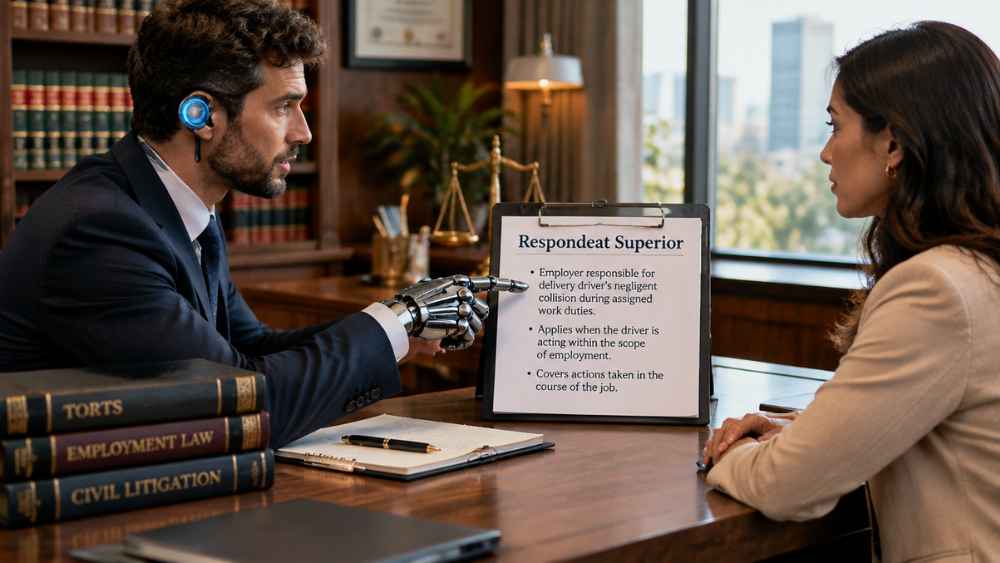
“The plaintiff alleged Respondeat Superior because the delivery driver caused the collision while completing assigned deliveries for the employer.”
What Is Respondeat Superior?
Respondeat SuperiorVicarious LiabilityVicarious liability makes one party legally responsible for another person’s wrongful conduct because of their relationship. The doctrine commonly applies through respondeat superior when an employee commits a tort within the scope of...View definition is a vicarious-liability doctrine that can make an employer responsible for an employee’s wrongful acts.
The employee generally must act within the scope of employment.
Therefore, liability depends on the employment relationship and the conduct involved. See Cornell LII’s Respondeat Superior overview.
Standard Respondeat Superior — Sample Contract Language
Suppose a delivery driver negligently causes a crash while completing scheduled deliveries.
What Does Respondeat Superior Mean?
The phrase comes from Latin and is commonly translated as “let the master answerCivil LitigationCivil Litigation is the court process for resolving noncriminal disputes through pleadings, motions, discovery, settlement, trial, judgment, and possible appeal. Federal civil litigation follows the Federal Rules of Civil Procedure, while state systems...View definition .”
Modern cases usually speak in terms of employer and employee rather than master and servant.
Therefore, the doctrine reflects responsibility arising from a work relationship.
Is Respondeat Superior a Form of Vicarious Liability?
Yes. Respondeat superior is one of the most common forms of vicarious liabilityCopyright InfringementCopyright infringement occurs when someone violates an exclusive copyright right without authorization or another valid legal basis. Claims can involve copying, derivative works, distribution, performance, display, or secondary liability, subject to defenses and...View definition .
It imposes liability based on the relationship rather than the employer’s own negligenceBreach of DutyA breach of duty occurs when a person or entity fails to meet a legal duty owed to another person. In negligence cases, breach is usually one element alongside duty, causation, and damages,...View definition .
Therefore, the employer can be liable even without personally committing the tort.
What Must a Plaintiff Usually Show?
A plaintiffCivil CourtCivil court is a general term for a court handling noncriminal disputes involving people, businesses, organizations, or government entities. Civil cases can involve contracts, injuries, property, employment, civil rights, and other disputes and...View definition generally must show an employment or agency relationship and wrongful conduct within the relevant scope.
State law supplies the precise test.
Therefore, the elements vary across jurisdictions.
Who Is the Employer?
The employer is the person or entity with the legally relevant right of control over the worker.
Payroll labels do not always control classification.
Therefore, courts can examine the real working relationship.
Who Is the Employee?
An employee generally performs work subject to the employer’s right of control.
Independent contractors usually retain more control over how they perform the work.
Therefore, worker classificationIndependent ContractorAn independent contractor is a self-employed person or business providing services without employee status under the applicable legal test. Classification depends on actual facts, and tax, wage, labor, and state laws can use...View definition can determine vicarious liability.
What Is Scope of Employment?
Scope of employment describes conduct sufficiently connected to the employee’s assigned work.
Courts consider purpose, time, place, authorization, and foreseeabilityReasonable Person StandardThe Reasonable Person Standard is an objective legal measure used to evaluate whether conduct was reasonably careful under the circumstances. It is central to negligence law and can be adjusted for children, physical...View definition under state law.
Therefore, not every act during work hours falls within scope.
What Is the Purpose Test?
Some courts ask whether the employee acted at least partly to serve the employer.
Purely personal conduct can fall outside employment scope.
Therefore, mixed motives can create factual disputes.
What Is the Enterprise-Risk Approach?
Some jurisdictions focus on whether the employment created or increased the risk that produced the harm.
This approach can be broader than a strict motive inquiry.
Therefore, state precedentMajority OpinionA majority opinion states the reasoning and result supported by more than half of the judges participating in an appellate decision and can provide binding precedent.View definition should control the analysis.
What Is a Frolic?
A frolic is a substantial departure from work for the employee’s personal purposes.
A true frolic can place conduct outside the scope of employment.
Therefore, employers often argue that major personal detours break vicarious liability.
What Is a Detour?
A detour is a smaller personal deviation that can remain within employment scope.
The distinction from a frolic is usually factual.
Therefore, time, distance, purpose, and work connection all matter.
Does Commuting Fall Within Scope?
Ordinary commuting often falls outside the scope of employment under the going-and-coming rule.
Exceptions can apply for special errands, travel duties, or employer-created risks.
Therefore, commute cases require jurisdiction-specific analysis.
What Is a Special Errand?
A special-errand exception can apply when an employer directs an employee to perform a particular work-related trip.
The trip can extend employment scope beyond ordinary commuting.
Therefore, travel purpose matters.
Can Employers Be Liable for Vehicle Accidents?
Yes. Employers can face respondeat superior claims when employees cause collisions during work-related driving.
Delivery routes, service calls, and business travel provide common examples.
Therefore, vehicle ownership alone does not decide scope.
Can an Employer Be Liable for Intentional Torts?
Sometimes. Intentional torts can fall within scope when sufficiently connected to assigned duties or foreseeable employment risks.
States apply different tests.
Therefore, assault and misconduct cases require close factual analysis.
Can an Employer Be Liable for Employee Fraud?
Potentially. Fraud can create vicarious liability when the employee acts with apparent work authority or within assigned functions.
Other agency doctrines can also apply.
Therefore, fraud cases can involve both tort and agency principles.
Does the Employer Need to Know About the Wrongdoing?
No. Vicarious liability can apply even when the employer did not know about the specific wrongful act.
That feature distinguishes respondeat superior from negligent supervision.
Therefore, lack of prior knowledge is not always a defense.
Does the Employer Need to Be Negligent?
No. Respondeat superior does not ordinarily require proof that the employer acted negligently.
The employee’s tort and employment relationship supply the vicarious basis.
Therefore, an otherwise careful employer can still face liability.
What Is Negligent Hiring?
Negligent hiring is a direct claim alleging that the employer carelessly hired an unfit worker.
It requires proof about the employer’s own conduct.
Therefore, it differs from respondeat superior.
What Is Negligent Supervision?
Negligent supervision alleges that an employer failed to reasonably monitor or control an employee.
The employer’s own fault is central.
Therefore, direct and vicarious claims can coexist.
What Is Negligent Retention?
Negligent retention concerns keeping an employee after the employer knew or should have known of an unreasonable risk.
The elements vary by state.
Therefore, the claim focuses on employer fault rather than imputed fault.
Can Both Employer and Employee Be Liable?
Yes. The employee remains personally responsible for the employee’s own tort in many cases.
The employer can become additionally liable through respondeat superior.
Therefore, plaintiffs often name both parties.
What Is Joint and Several Liability?
Joint and several liabilityLiability DefinitionLiability means legal responsibility for an act, omission, debt, loss, or other obligation. Liability can arise from negligence, contracts, statutes, strict-liability rules, or responsibility for another person’s conduct.View definition can make one liable defendant responsible for more than that defendant’s allocated share in some jurisdictions.
Comparative-fault statutesPrimary AuthorityPrimary Authority is law issued by an institution with official power to create or state legal rules. Constitutions, statutes, regulations, court decisions, and court rules can be primary authority, while binding effect depends...View definition can modify the doctrine.
Therefore, damage allocation depends on state law.
Are Independent Contractors Covered?
Usually, an employer is not vicariously liable for the torts of a true independent contractor.
Important exceptions can apply.
Therefore, contractor status and exception doctrines both matter.
What Are Common Independent-Contractor Exceptions?
Exceptions can involve nondelegable duties, inherently dangerous work, negligent selection, or apparent agency.
State law defines the categories.
Therefore, a contractor label does not automatically eliminate liability.
What Is Apparent Agency?
Apparent agency can create liability when a principal’s conduct reasonably causes others to believe a person acts as its agent.
The doctrine is distinct from ordinary employee respondeat superior.
Therefore, hospitals and service businesses can face apparent-agency disputes.
What Is a Nondelegable Duty?
A nondelegable duty remains the responsibility of the person or entity owing it despite delegation.
Contracting out performance does not always remove liability.
Therefore, independent-contractor defenses can fail for certain duties.
What Is Agency Liability?
Agency lawActual AuthorityActual authority is authority a principal grants to an agent, either expressly or by implication, based on the principal-agent relationship.View definition can make a principal liable for conduct of an agent acting within actual or apparent authorityApparent AuthorityApparent authority can bind a principal when the principal's manifestations reasonably cause a third party to believe an agent has authority, even without actual authority.View definition .
Respondeat superior is closely related but commonly focuses on employees.
Therefore, agency and employment analysis can overlap.
Does Respondeat Superior Apply to Corporations?
Yes. Corporations act through employees and agents.
Vicarious liability can make a corporation responsible for qualifying conduct by those people.
Therefore, corporate status does not shield the entity from employee torts.
Does It Apply to Partnerships?
PartnershipBusiness FormationBusiness formation is the legal process of creating and organizing a business entity. It can involve choosing a structure, filing state documents, establishing governance, documenting ownership, obtaining tax identifiers, reviewing licenses, and planning...View definition statutes and agency law can impose liability for partners or employees acting in the ordinary course of partnership business.
The details vary by jurisdictionLegal DisputeA legal dispute is a disagreement or controversy involving claimed legal rights, duties, liabilities, property, or remedies. It can be resolved through negotiation, mediation, arbitration, administrative proceedings, litigation, or settlement depending on the...View definition .
Therefore, entity form affects the applicable rule.
Does It Apply to Government Employers?
Government liability depends on sovereign immunitySovereign ImmunitySovereign Immunity generally prevents suits against a sovereign government without consent. Federal and state immunity use different rules, while statutory waivers, congressional abrogation, Ex parte Young officer suits, the FTCA, and other exceptions...View definition , statutory waivers, and scope-of-employment rules.
The Federal Tort Claims Act provides one federal example.
Therefore, ordinary respondeat superior concepts can interact with immunity law.
What Is the Federal Tort Claims Act Connection?
The FTCA can make the United States liable for certain torts committed by federal employees acting within scope of employment.
The statuteStatutory LawStatutory law is written law enacted by a legislative body through the formal lawmaking process. Federal and state statutes can create rights, duties, prohibitions, causes of action, procedures, penalties, and remedies, and courts...View definition contains administrative prerequisites and exceptions.
Therefore, federal employee tort claims require statutory analysis. See 28 U.S.C. § 1346(b).
What Is the Westfall Act?
The Westfall Act generally substitutes the United States for federal employees in covered common-law tort suits arising within employment scope.
Certification and exceptions can become important.
Therefore, federal employee cases can shift from individual liability to FTCA procedure.
Can Employers Seek Indemnity From Employees?
Sometimes. Employment agreements, statutes, or common-law principles can allocate reimbursement duties.
Public policy can limit indemnityThird Party ComplaintA third-party complaint uses Rule 14 impleader to bring a nonparty into a lawsuit when that person may be liable to a defending party for all or part of the original claim.View definition in some contexts.
Therefore, employer payment does not always end internal allocation questions.
Does Insurance Cover Respondeat Superior Claims?
Commercial general liability and auto policies can cover many vicarious-liability claims subject to policy terms.
Exclusions and insured definitions matter.
Therefore, coverage should be reviewed early.
Who Decides Scope of Employment?
A juryJuryA Jury is a group of citizens selected to perform a legal factfinding or charging function. Petit juries decide facts and return verdicts in trials, while grand juries determine whether probable cause supports...View definition often decides disputed facts about scope of employment.
A court can decide the issue when material facts are undisputed.
Therefore, scope can be either a factual or legal question.
Respondeat Superior Example
Suppose a delivery driver negligently causes a crash while completing scheduled deliveries.
The driver acts within assigned work duties.
Therefore, the employer can face respondeat superior liability for the collision.
Why Does Respondeat Superior Matter?
The doctrine places work-created risks on employers that benefit from and control employee activity.
However, scope, worker status, contractor exceptions, and state-law tests can change the result.
Therefore, employment context is central to every analysis.