
Vicarious Liability
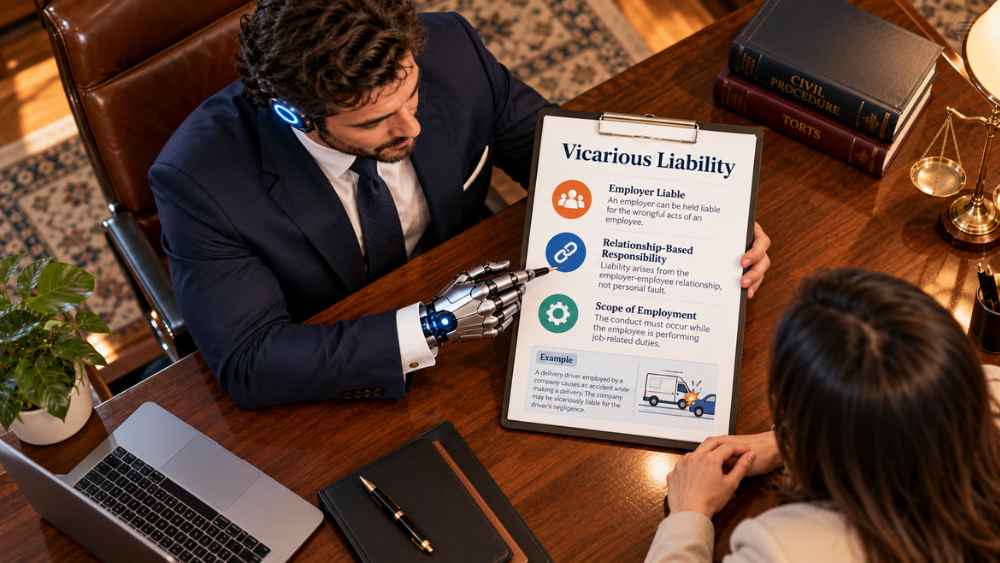
“The plaintiff alleged vicarious liability because the delivery driver caused the collision while performing scheduled deliveries for the employer.”
What Is Vicarious Liability?
Vicarious liabilityCopyright InfringementCopyright infringement occurs when someone violates an exclusive copyright right without authorization or another valid legal basis. Claims can involve copying, derivative works, distribution, performance, display, or secondary liability, subject to defenses and...View definition makes one party legally responsible for another person’s wrongful conduct because of their relationship.
The doctrine often applies to employers and employees.
See Cornell LII’s vicarious liability overview.
Standard Vicarious Liability — Sample Contract Language
Suppose a delivery driver negligently causes a collision while making scheduled deliveries.
What Is the Purpose of Vicarious Liability?
Vicarious liability allocates certain risks to a party connected to the person who caused the harm.
It can also encourage supervision, training, and risk control.
Therefore, liability can exist even without direct wrongdoing by the responsible party.
What Is Respondeat Superior?
Respondeat superiorRespondeat SuperiorRespondeat Superior is a vicarious-liability doctrine that can make an employer responsible for an employee’s wrongful conduct within the scope of employment. State law controls the scope test, worker classification, contractor exceptions, intentional-tort...View definition is the doctrine that can make an employer liable for employee torts committed within the scope of employment.
The phrase means “let the superior answerCivil LitigationCivil Litigation is the court process for resolving noncriminal disputes through pleadings, motions, discovery, settlement, trial, judgment, and possible appeal. Federal civil litigation follows the Federal Rules of Civil Procedure, while state systems...View definition .”
Therefore, it is the most familiar form of vicarious liability.
Employer Liability for Employee Torts
An employer can be liable when an employee commits a tort while acting within the scope of employment.
State law defines that scope.
Therefore, the same conduct can produce different results across jurisdictions.
What Is Scope of Employment?
Scope of employment asks whether the employee’s conduct was sufficiently connected to assigned work.
Courts often consider purpose, time, place, and job-related activity.
Therefore, ordinary job duties are more likely within scope.
What Factors Affect Scope of Employment?
Courts can consider several facts.
- Authorization for the act.
- Timing during work hours.
- Location connected to work.
- Purpose benefiting the employer.
- Similarity to assigned duties.
- ForeseeabilityReasonable Person StandardThe Reasonable Person Standard is an objective legal measure used to evaluate whether conduct was reasonably careful under the circumstances. It is central to negligence law and can be adjusted for children, physical...View definition of the general conduct.
Therefore, scope is usually a fact-sensitive inquiry.
What Is a Frolic?
A frolic is a substantial personal departure from employment duties.
An employer is less likely to face vicarious liability during a true frolic.
Therefore, a major personal detour can break the employment connection.
What Is a Detour?
A detour is a minor personal deviation while an employee remains generally engaged in work.
An employer can still face liability during a detour.
Therefore, small deviations do not automatically end scope of employment.
Frolic vs. Detour
A frolic is a substantial departure from work.
A detour is a relatively minor deviation.
Therefore, the distinction can determine whether employer liabilityWorkplace HarassmentWorkplace harassment is unwelcome conduct that can violate employment law when it is based on a protected characteristic or protected activity. Federal law generally requires a qualifying job action or conduct severe or...View definition continues.
Can Commuting Create Vicarious Liability?
Usually, ordinary commuting falls outside the scope of employment.
However, exceptions can apply when travel itself serves a business purpose.
Therefore, company errands and special missions require closer analysis.
What Is the Going-and-Coming Rule?
The going-and-coming rule generally limits employer liability during an employee’s ordinary commute.
State exceptions can apply.
Therefore, work-related travel should be distinguished from ordinary commuting.
Can an Employer Be Liable for Driving Accidents?
Yes, when an employee causes an accident within the scope of employment.
Examples include delivery, sales travel, or jobsite transportation.
Therefore, vehicle use often raises respondeat superior issues.
Does Vehicle Ownership Decide Liability?
No. Ownership can be relevant but is not the only question.
The employment relationship and scope of workStatement of Work (SOW)A Statement of Work (SOW) defines project-specific scope, deliverables, schedule, performance standards, responsibilities, and acceptance requirements.View definition remain important.
Therefore, a personal vehicle can still create employer exposure.
Can an Employer Be Liable for Intentional Torts?
Sometimes. Intentional wrongdoing can fall within scope when it is sufficiently related to employment.
However, purely personal violence often falls outside scope.
Therefore, motive and job duties matter.
Can an Employer Be Liable for Employee Assault?
Potentially. Liability is more likely when confrontation is connected to assigned duties.
Examples can involve security, collections, or customer-control functions.
Therefore, job-created risks can affect scope analysis.
What Is Direct Employer Liability?
Direct liability arises from the employer’s own negligent or wrongful conduct.
Examples include negligent hiring, supervision, training, or retention.
Therefore, direct liability differs from vicarious liability.
Vicarious Liability vs. Negligent Hiring
Vicarious liability depends on the employee’s conduct and employment relationship.
Negligent hiring focuses on the employer’s own failure to use reasonable care.
Therefore, both theories can appear in the same lawsuitLawsuitA lawsuit is a legal dispute brought before a court for a decision or remedy. Civil lawsuits can involve pleadings, service, discovery, motions, settlement, trial, judgment, and possible appeal.View definition .
What Is Negligent Supervision?
Negligent supervision alleges that an employer failed to reasonably oversee an employee who created foreseeable risk.
The requirements vary by state.
Therefore, it is a direct-negligence theory.
What Is Negligent Retention?
Negligent retention concerns keeping an employee after the employer knew or should have known about dangerous unfitness.
The claim requires jurisdiction-specific elements.
Therefore, later misconduct can create separate direct liability.
Can Both Direct and Vicarious Liability Apply?
Yes. A plaintiffCivil CourtCivil court is a general term for a court handling noncriminal disputes involving people, businesses, organizations, or government entities. Civil cases can involve contracts, injuries, property, employment, civil rights, and other disputes and...View definition can sometimes allege respondeat superior and direct employer negligenceBreach of DutyA breach of duty occurs when a person or entity fails to meet a legal duty owed to another person. In negligence cases, breach is usually one element alongside duty, causation, and damages,...View definition together.
Evidence and state law determine which claims proceed.
Therefore, the theories should be analyzed separately.
Are Employers Liable for Independent Contractors?
Generally, principals are less likely to be vicariously liable for independent contractors.
However, important exceptions exist.
Therefore, contract labels alone do not decide the issue.
What Is an Independent Contractor?
An independent contractorIndependent ContractorAn independent contractor is a self-employed person or business providing services without employee status under the applicable legal test. Classification depends on actual facts, and tax, wage, labor, and state laws can use...View definition generally controls important aspects of how work is performed.
Classification tests vary by legal context.
Therefore, actual control matters more than the agreement’s title.
What Exceptions Apply to Contractor Liability?
Possible exceptions can involve nondelegable duties, inherently dangerous activities, retained control, or negligent selection.
State law defines each doctrine.
Therefore, outsourcing does not eliminate every risk.
What Is a Nondelegable Duty?
A nondelegable duty is an obligation that a party cannot avoid merely by assigning performance to another person.
The principal can remain responsible for certain contractor misconduct.
Therefore, statutory and public-safety duties deserve special review.
What Is Apparent Agency?
Apparent agency can create responsibility when a principal represents another person as its agent and a third party reasonably relies.
The precise elements vary.
Therefore, branding and representations can affect liability.
What Is Agency?
Agency is a legal relationship where one person acts on behalf of another subject to relevant control.
The principal can face responsibility for authorized agent conduct.
Therefore, agency lawActual AuthorityActual authority is authority a principal grants to an agent, either expressly or by implication, based on the principal-agent relationship.View definition extends beyond employment.
What Is a Principal?
A principal is the person or entity for whom an agent acts.
Principal liability depends on authority, relationship, and conduct.
Therefore, businesses should understand who can act for them.
What Is an Agent?
An agent acts on behalf of a principal under an agency relationship.
Agents can be employees or nonemployees.
Therefore, agency and employment are related but not identical.
Can a Partnership Create Vicarious Liability?
Yes. Partners can create liability for the partnershipBusiness FormationBusiness formation is the legal process of creating and organizing a business entity. It can involve choosing a structure, filing state documents, establishing governance, documenting ownership, obtaining tax identifiers, reviewing licenses, and planning...View definition through acts within partnership business.
Partnership statutesPrimary AuthorityPrimary Authority is law issued by an institution with official power to create or state legal rules. Constitutions, statutes, regulations, court decisions, and court rules can be primary authority, while binding effect depends...View definition also address partner responsibility.
Therefore, partner conduct can bind the enterprise.
Can a Corporation Be Vicariously Liable?
Yes. Corporations act through officersCorporation DefinitionA corporation is a legal entity created under state law that is separate from its owners, usually called shareholders. It can own property, enter contracts, incur debts, sue or be sued, and operate...View definition , employees, and agents.
Entity status does not prevent respondeat superior liability.
Therefore, ordinary business operations can generate tort exposure.
Can an LLC Be Vicariously Liable?
Yes. An LLC can be liable for torts committed by workers or agents within applicable agency rulesRegulatory ResearchRegulatory research identifies and analyzes current agency rules, statutory authority, guidance, enforcement materials, and regulatory history.View definition .
Owner limited liability is a separate issue.
Therefore, the LLC itself can owe damagesLegal RemedyA legal remedy is the relief a court or other authorized tribunal can provide after a legal right has been violated. Remedies can include damages, injunctions, restitution, specific performance, rescission, declarations, and other...View definition .
Can Hospitals Face Vicarious Liability?
Potentially. Hospitals can face liability for employees and sometimes apparent agents.
Physician employment status can be important.
Therefore, medical cases often involve detailed agency analysis.
Can Schools Face Vicarious Liability?
Potentially. Schools and districts can face liability for employee conduct under applicable law.
Governmental immunitySovereign ImmunitySovereign Immunity generally prevents suits against a sovereign government without consent. Federal and state immunity use different rules, while statutory waivers, congressional abrogation, Ex parte Young officer suits, the FTCA, and other exceptions...View definition can alter the analysis for public entities.
Therefore, defendant status matters.
Can Government Employers Face Vicarious Liability?
Sometimes. Tort-claims statutes can waive immunity for specified employee conduct.
Notice requirements and exceptions can apply.
Therefore, claims against public employers require specialized review.
What Is Imputed Liability?
Imputed liability is another term for responsibility imposed because of a legal relationship.
It often overlaps with vicarious liability.
Therefore, the responsible party need not have personally committed the tort.
Is Vicarious Liability Strict Liability?
It can resemble strict liabilityTort DefinitionA tort is a civil wrong arising from an act or omission that causes legally recognized injury or harm. Major tort categories include intentional torts, negligence, and strict liability, with remedies commonly including...View definition because the employer may be liable without personal negligence.
However, the employee still must commit an actionable wrong.
Therefore, vicarious liability depends on both the tort and the relationship.
Does the Employee Remain Liable?
Yes, generally. Vicarious liability does not automatically erase the employee’s own tort liabilityNegligence Per SeNegligence per se uses a qualifying statutory or regulatory violation to establish or influence the negligence duty-and-breach analysis when the law was designed to prevent the injury at issue.View definition .
The employer can become an additional liable party.
Therefore, multiple defendants can share responsibility.
What Is Joint and Several Liability?
Joint and several liabilityLiability DefinitionLiability means legal responsibility for an act, omission, debt, loss, or other obligation. Liability can arise from negligence, contracts, statutes, strict-liability rules, or responsibility for another person’s conduct.View definition can allow recovery of a judgmentCivil LawsuitA civil lawsuit is a noncriminal court action in which a plaintiff seeks a legal remedy from a defendant. The process can include jurisdiction, pleadings, service, discovery, motions, settlement, trial, judgment, enforcement, and...View definition from one of several liable defendants.
States vary greatly in using this rule.
Therefore, allocation rules should be checked locally.
What Is Indemnification Between Employer and Employee?
IndemnificationMaster Service Agreement (MSA)A Master Service Agreement, or MSA, sets recurring legal and commercial terms for an ongoing service relationship. The parties can then use SOWs, order forms, or schedules for project-specific scope, pricing, deliverables, and...View definition can shift financial responsibility between legally liable parties.
Contracts, statutes, or common lawCommon LawCommon law is law developed through judicial decisions rather than created only through statutes or regulations. Courts use precedent to apply and refine common-law rules, although legislatures can modify or replace those rules.View definition can control the result.
Therefore, liability to the plaintiff and internal allocation are separate questions.
Does Insurance Cover Vicarious Liability?
Often, commercial liability and auto policies cover qualifying employer exposure.
Exclusions, limits, and insured definitions still matter.
Therefore, insurance should be reviewed before incidents occur.
How Is Vicarious Liability Proven?
The plaintiff usually proves an underlying tort and a relationship supporting imputed liability.
Employment records, job descriptions, communications, and time records can be relevant.
Therefore, scope-of-employment evidence is often central.
Who Decides Scope of Employment?
Courts can decide clear cases as a matter of law.
Fact disputes often go to a juryJuryA Jury is a group of citizens selected to perform a legal factfinding or charging function. Petit juries decide facts and return verdicts in trials, while grand juries determine whether probable cause supports...View definition .
Therefore, the procedural postureCase BriefA case brief is a structured summary of a judicial opinion covering material facts, procedure, issue, rule, holding, reasoning, and disposition.View definition can affect outcome.
Vicarious Liability Example
Suppose a delivery driver negligently causes a collision while making scheduled deliveries.
The driver can face direct negligence liability.
The employer can also face vicarious liability because the driver was performing assigned work.
Why Does Vicarious Liability Matter?
Vicarious liability can make an employer or principal responsible for another person’s tort.
However, scope of employment and agency rules vary by jurisdictionLegal DisputeA legal dispute is a disagreement or controversy involving claimed legal rights, duties, liabilities, property, or remedies. It can be resolved through negotiation, mediation, arbitration, administrative proceedings, litigation, or settlement depending on the...View definition .
The key questions are practical. Who committed the tort? What relationship existed? Was the conduct connected to assigned work?